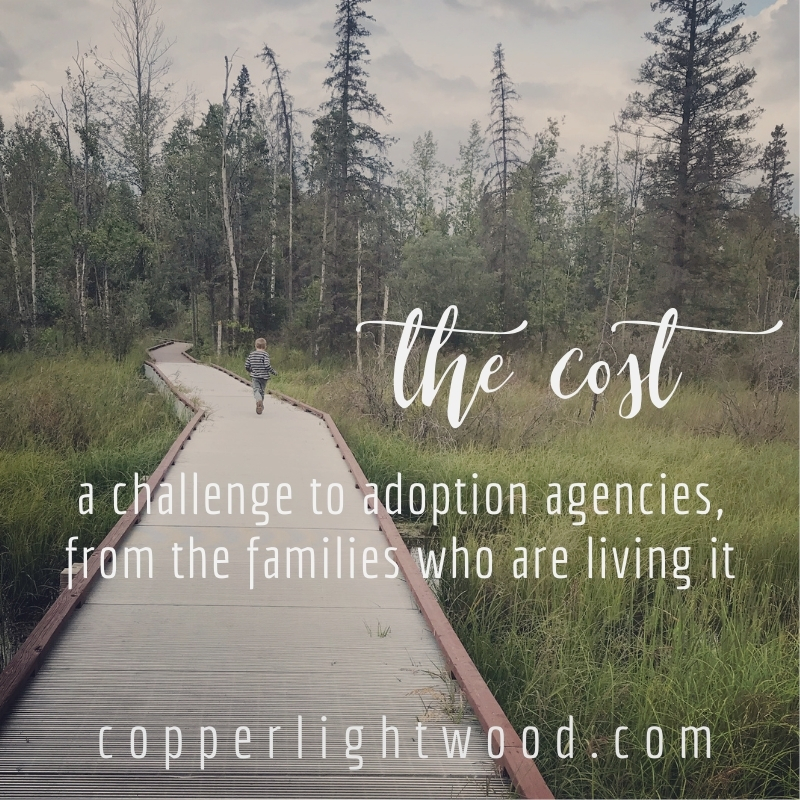
the cost: a challenge to adoption agencies, from the families who are living it

Thirty-seven thousand dollars. That’s how much it cost to adopt two of our children.

And that was – forgive me – a screaming deal. We adopted them at the same time, from the same country, on one adoption fee instead of two separate fees. Many adoptions cost that much or more just for one child.

the cost: a challenge to adoption agencies, from the families who are living it

Talking about the numbers and the money bothers me because children are not commodities. Ignorant people joke to adoptive families about buying or selling children, revealing their cluelessness about the reality of child trafficking. Adoption expenses are not a sale; it’s more like ransom money to get children out of institutions where they are languishing and put them into a family where they can heal.

And if you’ve adopted or have been a reader here for any length of time, you already know. Healing can take a long time.

And healing is worth it.

But here’s why I’m bringing up the money and numbers: Those costs do not come close to those incurred after adoption, literally and metaphorically. And people need to know that. People making insensitive jokes need to know; people thinking adoptive families get paid (what the what?!) need to know.

Potentially adoptive families need to know.

In discussing all the adoption costs with different agencies, it was never required (or even recommended) that we save for therapy. Personal health insurance was required, yes, but that doesn’t begin to cover the entire costs of therapy and counseling for multiple people in a family – parents, adoptive children, biological children – who undergo the turmoil, trauma, and secondary trauma those early adoptive years often involve. When you are replacing a destroyed mattress every six months for the first two years and repairing or replacing other damaged necessities, the copay for therapy becomes out of the question since it’s not a basic need.

We applied thousands of dollars to our international travel expenses. Hundreds of dollars were set aside to be converted to euro and lev just for meals. But also, it would have been good if we knew to set aside an account for therapy — $3000 to $5000 would have been a good start.

Why don’t adoption agencies require or recommend this? I mentioned it to a friend, and her response was, “They’ll never do it. Adoption agencies are making a sale, not equipping people for life after adoption.”

It sounds jaded, but from my experience I have to agree with her. Are we wrong? I hope adoption agencies will prove it.

It’s not just adoption agencies, though. Friends who adopted through foster care and private adoption said this:

NO ONE PREPARED US. And we know they knew. Other families were and are our saving grace in this area of support.

It would have taken just one home study writer or one agency worker thirty minutes to give us the real low down, and no one ever did.

I contacted our adoption agency three times about Upside Down after it gained the merit of being featured on Focus on the Family. I told them we hear from adoptive families all the time. Most of these families are desperate, and almost all of them tell us that Upside Down has the information they wish they had before they adopted. So I asked our adoption agency to consider making it one of their required (or at the very least, recommended) materials.

Three times I contacted them. Why three times? Because I never heard back. Not once.

We adopted two children with that agency. We are one of their families. And I never heard back.

Maybe my friend is right. Maybe they are more interested in the sale, and not interested in equipping families. Maybe they are concerned about losing a sale if they scare people off.

(Maybe, after the obligatory first two years of intrusive home visits by a 20-something social worker whose sole parenting experience was with her biological toddler in a two-income family, they figured we’d consumed the entire plethora of support they offered and we were on our own. Or maybe that was just us.)

But here’s the thing: If a family is easily scared off after reading a 100-page book or being told that part of the requirement for adoption is to save a few thousand dollars in an account for future therapy, those families should not be adopting in the first place. This is an easy filter.

I’ll be contacting that agency again soon, and several others also. We’ll see if the response is better this time. (UPDATE: After some emails back and forth over about 6 months, our former agency last told us they got a copy of the book and were still reviewing it — it’s a 40 minute read, front to back — and then declined to return my phone call or last email. So it sadly looks like they are in the business of selling adoptions, and not supporting adoptive families.) And if you are an adoptive family, you are welcome to contact your agency and recommend materials you wish you’d had when you were in process, too.

Meanwhile, though, what can we do for adoptive families now? How can we encourage and empower them, and help them toward wholeness? What can we offer to potential adoptive families who are rightly curious about what they might be signing up for?

We can be honest with them, because what we’ve learned hasn’t come cheap. We can be as transparent as possible while still honoring the privacy of our kids and families.

The core of adoption support is not going to come from professionals who don’t have personal adoption experience. Those services are basic and they can help, but the most impactful support to adoptive families is going to come from other adoptive families who have been there. If that weren’t the case, one of the most common things we hear from adoptive families wouldn’t be “I would never tell this to someone who hasn’t adopted, but I know you understand.”

But that’s what we hear, because we do understand. Nine years later, we’re still walking this out every day.

So here is some of that honesty from a mom who’s been there: Don’t Make Me Use My Mom Voice: Adoption, Attachment, & Discipline, a 1-hour training by yours truly. This was originally requested by an adoption agency who is actively equipping their families, and now we’re making it available to other adoptive (or potentially adoptive) families who need it. Foster families, too. This training will help you feel more equipped in all your parenting and relationships and personal wholeness.

We need people who have been where we are – and are still walking that road – to come alongside us and say, You’re not alone. You’re right, you really do know what you’re talking about even when you don’t feel like you know nearly enough to do this. This is really hard, but we’re going to get through it.

And that’s cheaper than therapy.

what we know: tools for adoptive and foster families

How hard is it to read the word “graph” when you know all the sounds? On a good day, not hard at all. But on a rough day when you’re operating from fear and control, impossible.

“What do the letters ‘ph’ say together?” I ask. He knows this.

what we know: tools for adoptive and foster families

Not only does he know this, but I just coached his sister through reading the word “sphere” two minutes earlier, so he just had a refresher course in the “ph” sound. And that might be the very reason he’s choosing this hill to die on – it makes it all the more obvious that he does know, but You Can’t Make Me Tell You.

“Ape,” he says.

We both know it’s wrong. He does a quick extra chore to regroup while I work with someone else.

I ask again. “Ape,” he says, knowing it’s still wrong, it will always be wrong, never in a million years will “ph” ever say “ape,” but if I asked him what his name is right now, he’s just as likely to answer “Hippo.” Or, you know, “Ape.”

Another chore. Wash some windows. Specifically, “Wash the two windows behind you,” I tell him.

He starts doing a third window, though. So I say, “Go ahead and finish that one. You can do three.”

He stops half way through the last one.

“I’m done,” he says. We both know it’s not true.

“How many windows did I tell you to do?”

“Three.” Okay, kind of. I’ll give him that.

“How many did you wash?”

“Four.”

“Really? How’s that?”

He counts the panes, two on each window – one, two, three, four.

“So how many did you wash?”

“Three.”

Because two plus two is three. Because what he’s really saying is, Ef you. You can’t make me.

And I can’t. We both know that’s true. But what he doesn’t understand yet, is I don’t want to make him.

I want him to do it himself. For himself. Because he is loved, and he is valuable, and his days are valuable. I know it’s true. Some days, I think he might finally believe it’s true, also. But not today.

Not all days are like this. It used to be, for years, that every day was like this and worse (so much worse), but now he goes in phases – good days and bad days, great weeks and terrible weeks.

But it’s Christmas time, and right now he’s having some really hard days, because festivities and gatherings and events, oh my. The turmoil this brings up for kids with a background of trauma can be immense, sometimes catastrophic.

But it’s nothing like it used to be.

It used to be, we had to avoid almost everything that involved people because people didn’t know how much their well-intentioned interactions with our kids cost our family.

It was easier to just avoid them. We could at least avoid those triggers…but isolation also cost our family.  

Eventually we learned how to communicate what our kids’ needs were to the people around us – family, friends, our church, our school, our medical professionals. And that quickly helped us discover who “our people” were – they were the ones who respected the boundaries our kids needed. The ones who didn’t, weren’t.  

If this sounds familiar to you, I have some quick resources for you to help the holiday season be more fun than a root canal without anesthesia. Been there, hated that. Some days, as you can tell, we’re still there. But it’s nothing like it used to be.

This post explains the Why Behind the Weird Limits to our people. It helps family, friends, teachers, and other professionals understand exactly why it is such a no no to overstep attachment boundaries with kiddos who have a background of trauma. It’s chapter 2 from Upside Down: Understanding and Supporting Attachment in Adoptive and Foster Families.

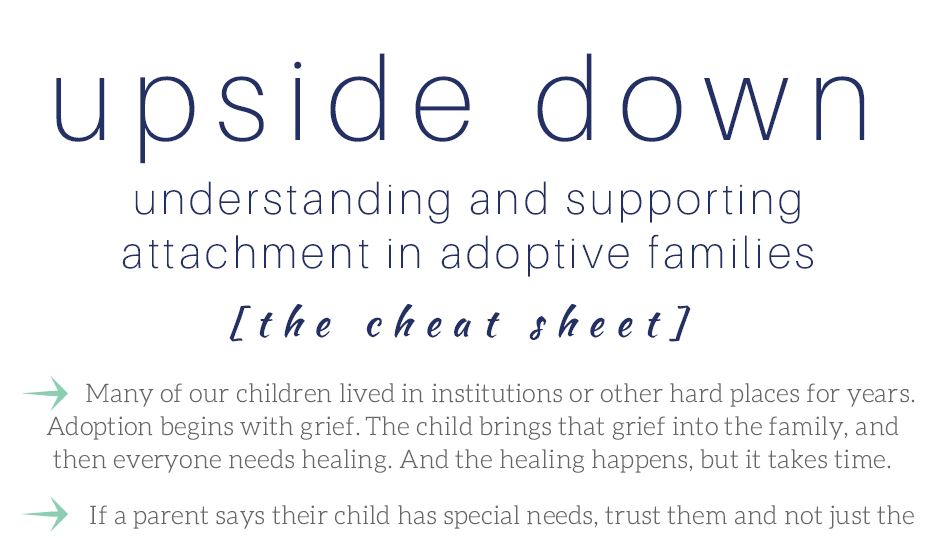
Or there’s this: The Upside Down Cheat Sheet is a quick, one-sheet reference. Don’t be afraid to click on it; it’s a free download, no signup required, with a few basic principles to remember. Print it out and give it away as much as you want. If you charge people for it (good luck with that), I will find you…and I’ll ask you to share your savvy marketing skills with me.

And, need the whole book? It’s just 100 (ish) pages – a quick, easy read, and it’s funny. Because I’m funny. At least, my friends think so. You can buy it in stores everywhere or get it directly from us and take advantage of our discounted prices for buying multiple copies. It’s also now available in audio here. Everyone needs this information and we want to make it easy for you to have it, because adoptive and foster families need real support and understanding from their people. If our community can learn, yours can, too.

So that is a look into our fishbowl, seven years into this. At least the windows are clean.

May your gatherings be filled with joy, and your home be filled with peace and as little aftermath as possible. What you’re doing is hard, but you’re doing a good job. And that’s the truth.

work in progress: what happens when we fill the lake

Reagan is next to me, reviewing letter sounds. And not just that, but she’s also reviewing other important things, like how to pronounce “the” like thuh, not duh – and she plods through all of them in order: Thuh…E…says…ehh. Thuh…F…says…fff, and so on. It may be the first time in my life I’ve ever wished the English alphabet had less than 26 letters.

work in progress, part 1: what happens when we fill the lake

People often ask how we homeschool all these kids (“all these kids,” they say, as though we’ve collected them like so many postage stamps) and I hate to disappoint them, but the answer is pretty boring:

We don’t, really.

At least, not anymore. We put in our time with the older ones when they were younger, and now they mostly homeschool themselves; we just check and discuss their assignments and read with them a little. Life is all learning, of course, but as far as school goes, they’re pretty independent now.

So school-wise we direct our efforts to working with the Littles, as far as they will cooperate, which is…ah, how do I put this…extremely variable. And if you know us, you know that the category of “Littles” has less to do with age and more to do with ability and maturity. Our big kids are 18, 15, almost 13, and 9; our Littles are 13, 13, 3, and 2 months. Our 18-year-old recently moved out, and our little Kavanagh is just learning to take the world in. He’s growing like a weed; he smiles and laughs. Which might all be the same thing.

Last month I made filling the lake a priority again, and it’s working. I’m remembering that this is why we chose to write from home full time: I feel alive again when that’s what I’m actually doing, as opposed to the administrative, publishing parts that consume certain phases of it.

When we like what we’re doing, we forget that we’re working.

I like the movement of standing up to reach over the back of my laptop to grab a favorite style guide from my stack of writing books on the back of my desk. And I like having a row of finished works next to them, and different notebooks and journals scattered all over the place.

I like that one of the works-in-progress is not just a digital file like the one I’m currently typing on, but it’s a stack of research materials, a notebook, and Oh My Soul and its companion journal. Eric Liddell said he felt God’s pleasure when he ran; I feel God’s pleasure when I am in full nerd-mode with a pencil behind my ear, going through familiar books, rifling through pages and marking up passages, and typing as the words flow easy, fast, and furious.

And I even kind of like it – in a perverse, self-flagellating way – when I am in front of the laptop with no words, frustrated with the wrong words, and aggravated as all get out trying to pull a piece together before a deadline when the clock is ticking down (like right now, she thought nervously), because I know the thrill of accomplishment and relief when it’s done.

I don’t love it so much that I forget that I’m working, but I know that it’s worthwhile because whatever I’m doing is working. Purpose comes easier when we see the headway we’re making.

Like when Reagan pushes through and makes it to Thuh Z says zzz – it’s progress, and she is gaining. In the effort and aggravation, we see achievement and increase, and it’s worth it. You know, sort of like childbirth: Ta da, look, we did it. We made this.

The other day one of my kids asked me for harder books, but she didn’t say it that way. She said she wanted “books that would take longer than a day to read” and I had the happy task of going through the library with her to find a new stack that would keep her occupied. She didn’t want The Hunger Games, she wanted the challenge: The Scarlet Pimpernel, Mother Mason, My Antonía.

And this is when I love homeschooling and forget that it, too, is work: Learning, like teaching or writing or any other job, ceases to be work when we get lost in it.

Along those lines, this month I got to dig into the first chapters of Bleak House with my writing student. I almost wrote “dive” into it, but no, one does not dive into anything of Dickens. You wade in cautiously, stir a foot around the water to check for sharp objects, and, finding none, keep going deeper and deeper until you’re surrounded by 43 characters swimming around and splashing you in the face and pulling you under, and you like it. At least, I do.

And I might as well confess up front that I’m already reading Pickwick Papers with Iree and Nicholas Nickleby (one of my favorites) with the family as a read aloud. So, no, I didn’t pick Bleak House, but I’ve read it before and was thrilled that my student chose it.

Each of us read from our own copies. I leaned over to see where she was at, and she was a full page ahead of me, because I had gotten lost in sentences like,

Smoke lowering down from chimney-pots, making a soft black drizzle, with flakes of soot in it as big as full-grown snow-flakes—gone into mourning, one might imagine, for the death of the sun.

And I forgot I was supposed to be working.

So now I find myself in the middle of three, count ‘em, three Dickens novels, and perfectly happy about it. Vin thinks I might have issues. I think I might want to be a Dickens scholar when I grow up…and that, too, might be the same thing.