
roundabout: how we navigate life’s imperfect situations

On my way to jury duty but otherwise minding my own business, I drove through the roundabout and saw flashing lights in the rearview mirror.

I already have complicated feelings about roundabouts.

It’s been thirty years since I’ve been pulled over, and in my defense the legal speed limit at the time was not what it should have been and they later raised it, thankyouverymuch. So I wondered if this officer was just passing me on his way to someone else.

But no, he pulled over right behind me. I rolled down my window and looked out.

roundabout: how we navigate life's imperfect situations

As he walked up, he was quick to reassure me. “Hey ma’am, I pulled you over because your brake lights aren’t working. I followed you for a while and neither of ‘em went off at the roundabout, it might be a fuse issue.”

“What?” Stunned relief. I passed him my ID and asked, “Is this a good time to tell you one of my headlights is out, too? Because that’s why those aren’t on.” I pointed at the new part Vin had just picked up the day before, waiting in the dashboard pocket.

He smiled; just a warning, no citation. Headlights go out, fuses trip, and life happens. We all have bigger fish to fry, and I even made it to jury duty on time with a couple minutes to spare.

Life is a series of obstacles and other imperfect circumstances: disappointments and frustrations, emergencies and trauma. We need grace and mercy in the roundabouts, and wisdom to know how to move through them.

I have given citations when I should’ve given a warning. Also, I have given warnings when a citation would’ve been much better. We need so much grace and wisdom.

Our family terrain – and probably yours, too – is filled with obstacles. Boulders, caverns, and sudden drop offs, and I don’t know how to bridge them, move them, go around them. While we navigate our own current roundabouts, we have friends dealing with medical crises, custody battles, kids or spouses going off the rails, leadership wounds, and major financial hurdles. So many obstacles to press through.

And while there are plenty of armchair quarterbacks with cheap advice that costs them nothing because they’re not responsible for actually implementing it, there is a real shortage of easy answers that lead to quick fixes. These situations have moved far beyond your basic roundabout; they look more like someone on the DOT took a drunken spree with a steamroller and attempted a series of figure eights.

Here’s what I’ve been confronted with, and the answer probably seems obvious: Will God still meet us when life is so messy? So different from everyone else’s? So off the map, and into uncharted wilderness?

Yes. Of course He does. He is, He will continue to do so.

(I am not referring to deliberate sin or a seared conscience. I am referring to living with the effects of what is often someone else’s sin, or the consequences of our own previous sin, or just the messiness of a fallen world and the cleanup operation we live in.)

We find ourselves in the midst of paperwork, requirements, and systems that we never wanted to be part of. Our house – and some others we know – have security measures in certain places they shouldn’t have to be. We don’t want them there any more than other people want to have to file for a restraining order or other legal protection.

And yet, here we are. Messy times.

But when life is messy instead of straightforward and simple, the enemy often convinces us that we are less than, unworthy, disapproved of, or unable to meet God, minister, or even just do life the way others do because our life does not look the way we thought it was supposed to. Somehow, it feels like we have to clean this up first – which of course is an impossibility. If we knew how to fix this or move past it (dynamite, anyone?) we would’ve done so by now.

These roads have not been straight and smooth. People and life events do not always progress predictably, meet all the prerequisites in perfect order, pass all the tests with high scores. Some are late bloomers, or got a rougher start, and have more roundabouts to navigate.

We are learning about grace and persistence. And also, braking and yielding.

Because God is wanting us to learn about what success really looks like.

So let’s talk about Solomon, and his imperfect start.


Solomon, in many eyes, was a picture of success. He’s known for wealth and wisdom. But that is only part of his story.

Let’s go back to a scene from the beginning:

The people were sacrificing at the high places, however, because no house had yet been built for the name of the Lord.

Solomon loved the Lord, walking in the statutes of his father David, except that he sacrificed and offered incense at the high places.

– 1 Kings 3:2-3

Like both kings before him, Solomon was not a perfect leader, and he began with some obstacles. “The people were sacrificing at the high places” – well, that’s bad, because it alludes to idolatry, but the verse says it’s because no house was built for the Lord yet. So this sort of looks like a “you do what you gotta do” situation.

The next verse says that Solomon loved the Lord – so far, so good – and that he walked “in the statutes of his father David” – uhhh, this could be a red flag. It’s the only place in the Bible that this phrase is used, and it’s significant that it doesn’t say Solomon “walked in the laws of the Lord” as it does elsewhere. If you know the full story of David (not the romantic flannelgraph version, but the truth that involves murder, rape, and neglect of responsibility), you know where this is going. Too many horses, too many wives, yada yada.

But at this early point, at least, unlike the two kings before him, Solomon wasn’t an imperfect leader due to his own character flaws and poor decisions. He was in an imperfect situation. This is what he inherited, what he walked into.

Or, you could say, this was the iniquity he lived in.

Wait, what?

We tend to think of iniquity as just meaning “sin” but it’s not quite the same as that, and we’ve talked about it before. To sum up, iniquity is more of a cultural or generational bent; a learned misbehavior. This is just the way things are, the way things are done; this is what we’ve always known and been taught…and it’s not necessarily the right way.

If it’s not good and true, it’s iniquity. We didn’t necessarily choose this imperfect situation; it’s what we walked into, grew up in, or found ourselves in the middle of, beyond our own choosing. It’s not right or okay, but it’s also not necessarily deliberate…and it needs to be dealt with.

But it’s not outright rebellion or disobedience, which is what we generally mean by “sin” (but more accurately termed transgression). So we deal with iniquity differently. And so does God.

At Gibeon the Lord appeared to Solomon in a dream by night, and God said, “Ask what I should give you.”

– 1 Kings 3:5

Solomon was just doing what he could with the circumstances at hand. It wasn’t ideal. It looked bad. And yet God still met him there.1 God didn’t care about appearances, because He knew what was going on in Solomon’s heart.

God is not waiting for us to perfect our circumstances to meet with us and work through us. He’s not accusing us of surface-level improprieties; He’s not insecure and worried that we’ll make Him look bad. He knows our hard situations (read: mindsets, family roots, patterns of thinking, systems embedded in culture) and He is still willing to meet us. In fact, He wants to.

He knows all about the obstacle in the path, and the roundabouts you and I are navigating.

That doesn’t mean God is smiling at sin or excusing a horrible situation, or that we don’t need to do what we can to change those things. In fact, our recognition that this situation is not the way it’s supposed to be – it is avon, crooked, misshapen – is the beginning of turning it straight again. Correction and healing cannot happen in a place of denial.

But it also means we don’t have to change them before hearing from Him. We can’t make the corrections if we’re not hearing from Him in the first place, because we need His wisdom for this.

God meets with Solomon at the high place anyway, and this is where Solomon famously asked for wisdom instead of all the other shiny things he could’ve requested, and God gave him wisdom plus everything else.

Then Solomon awoke; it had been a dream. He came to Jerusalem, where he stood before the ark of the covenant of the Lord. He offered up burnt offerings and offerings of well-being and provided a feast for all his servants.

– 1 Kings 3:15

After the dream, Solomon changed direction (we could call this repentance – he changed his mind and way of doing things) and faced God’s promise. And then he offered his sacrifices there, instead.


Sometimes we need to move somewhere new or set a boundary or start over to see breakthrough for the situation we’ve been fighting. But we also need to know that the Lord is with us now – in this place, and in these circumstances.

He is the God with us now, not the God with us later when we get our act together and have all the answers.

Some of us have been used to running to the new thing, away from the old thing, feeling like we had to cut ties or start over or move entirely for deliverance. And sometimes we do need to let go and move on.

But it’s not always the case.

Sometimes we’re just running, avoiding, desperate for any change, no matter how much worse it ends up, as long as we don’t have to keep facing this situation, here and now.

But we need to know that the Lord is faithful here and now. In the roundabout, as we are facing our obstacle.

Turn to me and be gracious to me,
as is your custom toward those who love your name.
Keep my steps steady according to your promise,
and never let iniquity have dominion over me.

– Psalm 119:132-133

He is faithful in the land of the living, in the place of our pain, at the table in the presence of our enemies.

If He’s not telling you to move, then stay. Stand. Hold your ground.

In the roundabout, we slow down. We have to hit the brakes to take the curve, and people ought to notice our brake lights so they don’t run into us. Wait, I need to think, give me a second.

Be careful, then, how you live, not as unwise people but as wise, making the most of the time, because the days are evil.

So do not be foolish, but understand what the will of the Lord is.

Do not get drunk with wine, for that is debauchery, but be filled with the Spirit, as you sing psalms and hymns and spiritual songs to one another, singing and making melody to the Lord in your hearts, giving thanks to God the Father at all times and for everything in the name of our Lord Jesus Christ, being subject to one another out of reverence for Christ.

– Ephesians 5:15-21

Others are on their own journey, taking the curve as well, and we all have to yield.

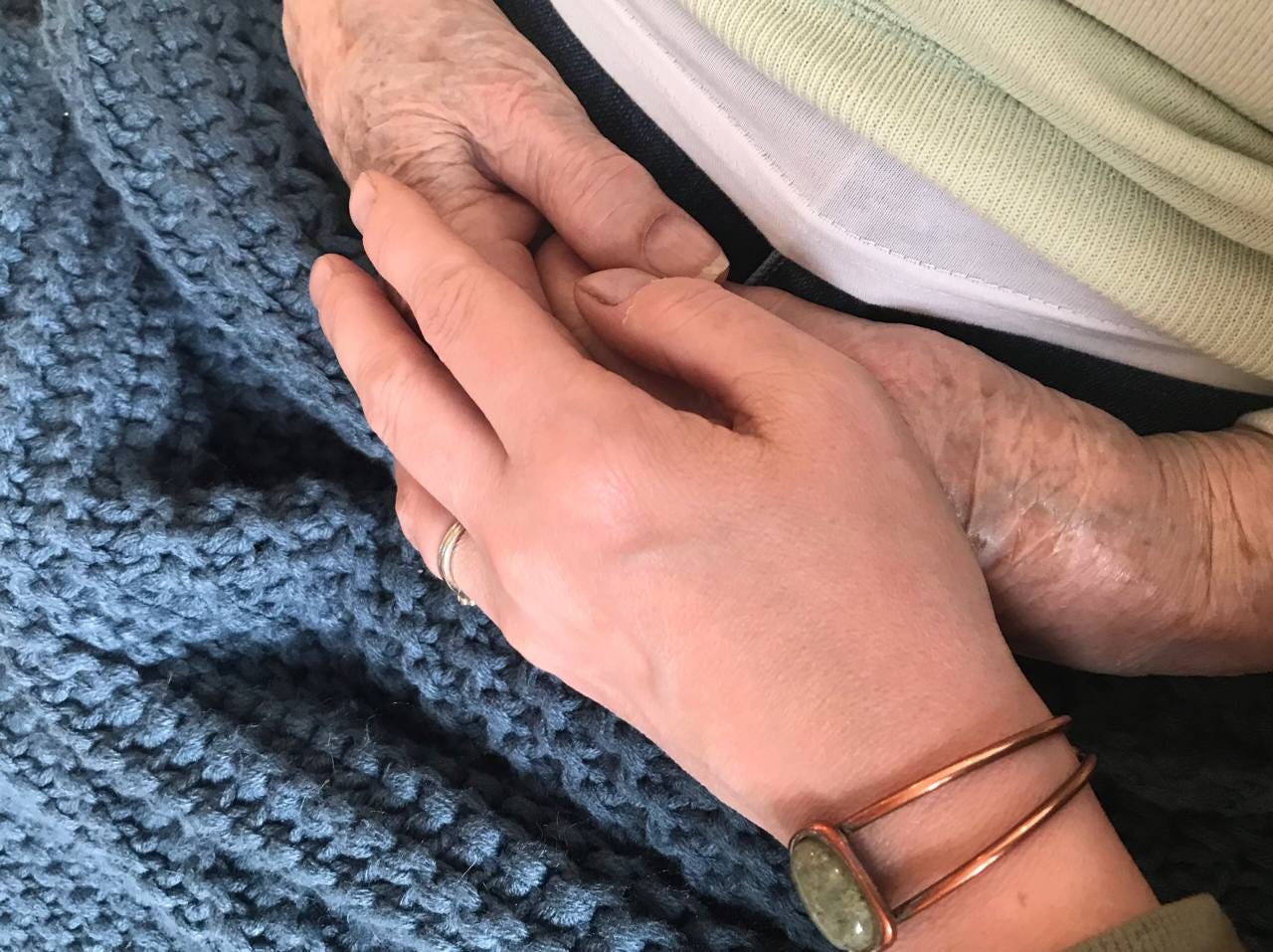
We are navigating the long goodbye to my grandma, a major house repair, and the inability to make someone choose rightly when the consequences of their wrong choices are coming at them fast.

You are navigating your own obstacles: a legal battle, a leader who dropped the ball, a work crisis, a family member whose dumpster fire is spreading dangerously close to your home.

We are learning to ask Him, “Will You show me today how faithful You are in this?” and to wait for the answer.

Consider and answer me, O Lord my God!
Give light to my eyes, or I will sleep the sleep of death,
and my enemy will say, “I have prevailed”;
my foes will rejoice because I am shaken.

But I trusted in your steadfast love;
my heart shall rejoice in your salvation.

— Psalm 13:3-5

He has an answer here, now, in this messy situation that looks nothing like it ought to.

He’s not testing us to see how much misery we can handle. He is teaching us to conquer fear so we can see how trustworthy He is.

He is teaching us peace in the place of fear, boldness instead of intimidation, and joy in the roundabout, instead of those curves causing us anxiety and nausea.

We are looking to Jesus because He is the roundabout, showing us the way through.


Thanks so much for reading! You can subscribe to get these posts for free, straight to your inbox, here. If you’d like to support our work, click here.


P.S. If you want to learn more about iniquity, don’t miss this quick video from BibleProject.

  1. Another great example of this is Esther, who was in a much worse situation (being abducted and forced to marry a pagan king), and yet still God met her and moved through her in faithfulness. This is a terrific post about her story. ↩︎

grit: how we wait & keep His way

I sat at one end of the couch, and our six-year-old with his pink cheeks was at the other. Our nine-year-old had the other couch, and both were banked by coffee tables littered with half-empty beverages.

Up too early with two feverish boys, trying to keep myself healthy and hydrated on only four hours of sleep, I remembered how just in the last post I said my mind was ambitious but my body said no, take a nap. And I wondered if this day would be the same but for different reasons.

grit: how we wait & keep His way | Shannon Guerra

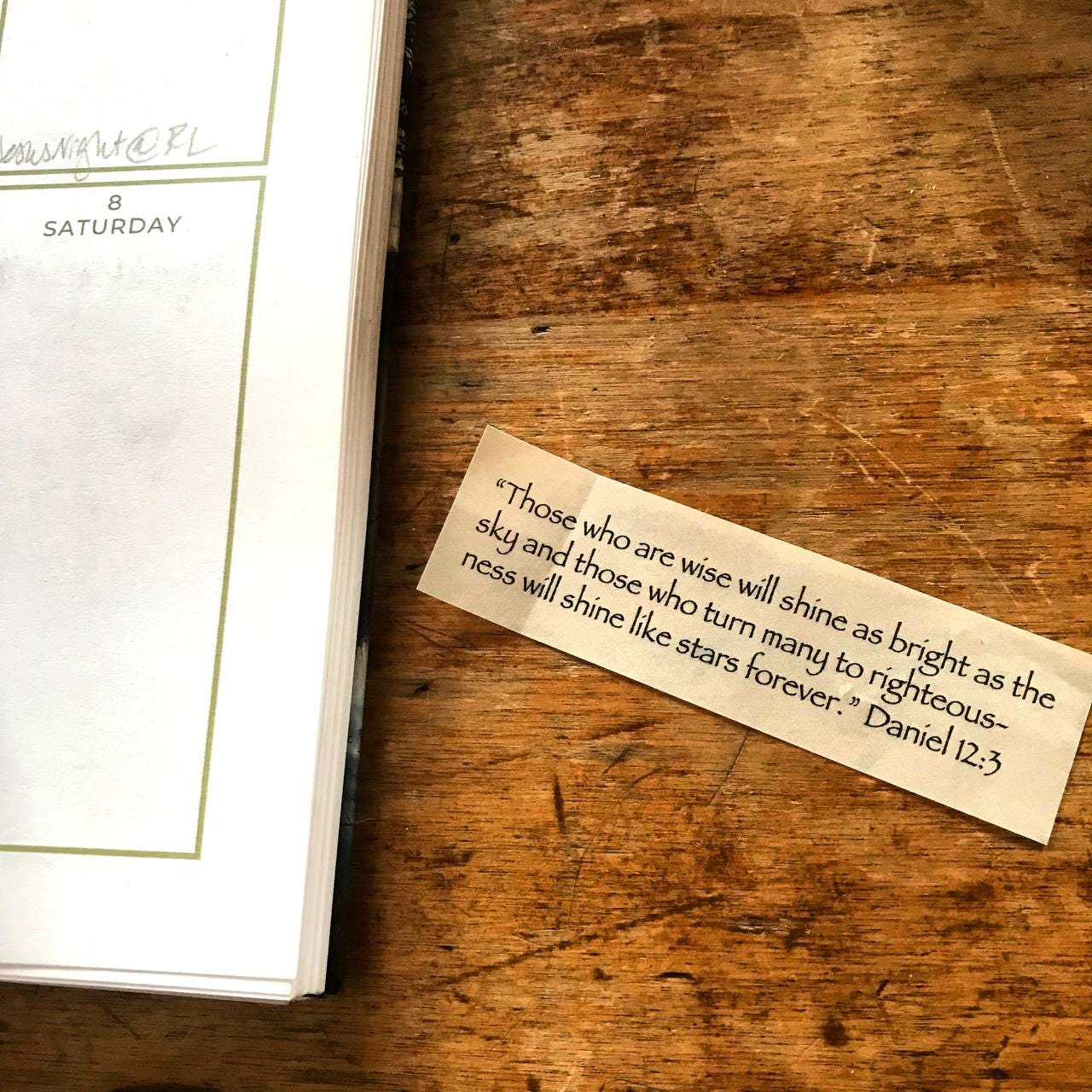
I had just written about limitations, so I guess it was fair that I got to relive it: Limits force us to focus. I could only reach my end of the coffee table, which held my tea, planner, bible, book for class, a scripture verse on a slip of paper, and The House of Seven Gables, all of which I’ve been working my way through.

That sounds productive, but I spent plenty of time just staring blankly out the window, watching the chickadees at the feeder and the cars on the highway. Also, I checked temperatures. Reminded Finn and Kav to drink their tea, and they made slow progress.

Both of the boys had a day – separately, though, praise God – when their fevers spiked high enough to peak with delirium and tachycardia, which is a fancy way of saying we could see their pulses tapping under the curve of their necks while they mumbled nonsense about ice cubes talking and the walls changing shape and color.

It was alarming, but twenty years of reading classic literature hasn’t been for nothing. Everyone who’s read Sense and Sensibility knows that Marianne raved incoherently before her fever broke, too.

So we kept their foreheads cool and let the fevers do their job. And they did, but when we thought they were finally on the mend, a new phase started with congestion and coughing, which didn’t seem fair because that’s not how it’s supposed to work. You’re supposed to get over whatever it is and move on with life, not just transition into a new form of sickness.

But no, two days later, both boys and I were all coughing and sniffling. Still drinking all the fluids and doing the right things, but also, still working our way through whatever it was. My head hurt when I turned too fast to look left or right, but I mostly felt fine as long as I didn’t do anything ambitious like leave the couch.

Sometimes we think we’re making progress, but then we suddenly realize there’s so much more ahead than we had anticipated. And it doesn’t feel like progress anymore; it feels more like discouragement, or even defeat.

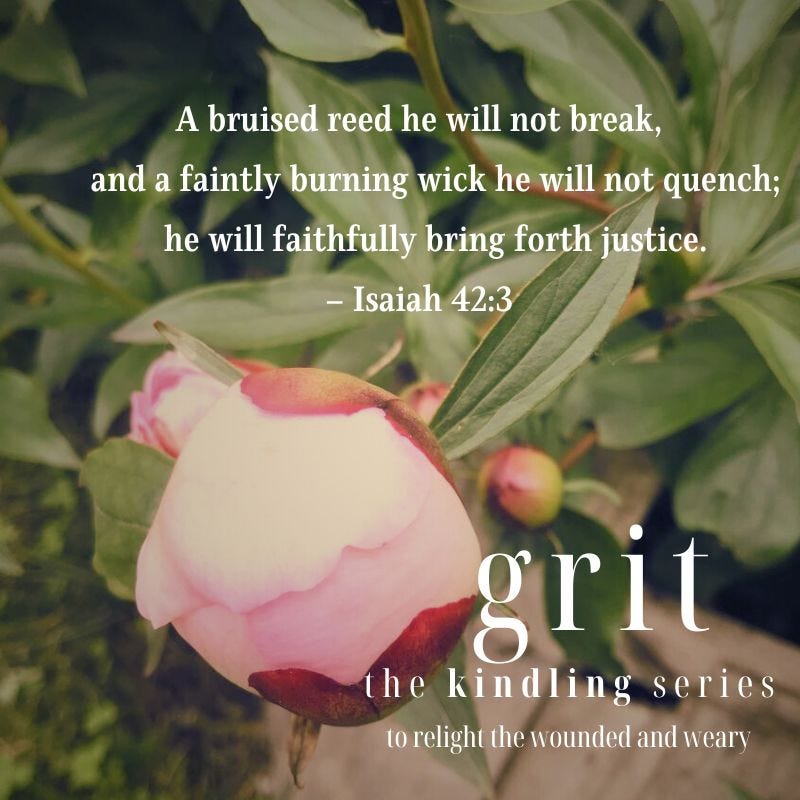
He sees you when small steps forward cause you to grieve, because it seems like they ought to be bigger steps forward by now…or they ought not to have been needed at all because the circumstances should never have happened.

You’re not in trouble for having mixed feelings over progress that restores the regress of hard situations.

It’s okay to be both grateful for the progress and grieved over its necessity.

He is doing something in both the grief and the gratitude.

– Grit: Kindling to Relight the Wounded and Weary

I gathered the empty cups and crumpled tissues, thought about the work that would need to be set aside for another day. Wondered how long it would last, and how much I wasn’t going to get done this week.

And then I heard the Lord say, What if this isn’t sickness, but immunity?

Because that’s what perseverance and grit develop.

Wait for the Lord and keep to his way,
and he will exalt you to inherit the land;
you will look on the destruction of the wicked.

– Psalm 37:34

When we learn to focus and persist in the task that’s right in front of us, we protect ourselves from a lot of the drama and distractions in our periphery. We’re not necessarily unaware, but we’re on a mission.

(Like right now, she typed, ignoring the cat who repeatedly walked across her lap, meowing for attention.)

Being stuck on the couch with sick kids is not all that different from being stuck on the couch nursing a baby, which is how I’ve spent almost eleven years of my adult life. Those were the short years filled with long days; different couch, but the same coffee table. Those slow days taught me to steward what was in reach no matter how chaotic everything else out of reach was – drink the water, read the book, memorize the verse. Look out the window, observe and pray.

And this, too, is progress.

Be still before the Lord, and wait patiently for him;
do not fret over those who prosper in their way,
over those who carry out evil devices.

– Psalm 37:7

A few weeks ago one of our pastors said the difference between persistence and stubbornness is the direction you’re going, and that’s familiar because we’ve talked about holy stubbornness for a looong time.

Things don’t always go the way we want, but when we practice patient self control, playing it cool, we look like Jesus because we’re doing what He did. The Bible, of course, doesn’t say He “played it cool;” it uses phrases like divine forbearance...but the essence is the same. We, too, are looking past the wrongs and trusting Him to bring things right as we press on in the face of less than ideal circumstances.

We’re doing what needs to be done, no matter how humble or ugly or unimpressive it seems. We’re pressing forward through the obstacles. And we’re letting go of the things out of reach, out of our jurisdiction and control.

We’re (a)biding our time in gritty surrender.

Our steps are made firm by the Lord
when he delights in our way;
though we stumble, we shall not fall headlong,
for the Lord holds us by the hand.

– Psalm 37:23-24

I didn’t want the kid to make that choice, I didn’t want to have to prune that relationship, I didn’t want that to happen. But it’s less about what we want, and more about how we respond once we see things as they are: Will we look to Him? Will we sit at His feet? Will we trust Him and forge ahead, however we’re able?

…let us also lay aside every weight and the sin that clings so closely, and let us run with perseverance the race that is set before us, looking to Jesus, the pioneer and perfecter of faith, who for the sake of the joy that was set before him endured the cross, disregarding its shame, and has taken his seat at the right hand of the throne of God.

– Hebrews 12:1b-2

We are image bearers, becoming Who we behold even (especially) when it’s not easy to keep our focus. Like Mary of Bethany, who defied all kinds of opposition – including her closest family member and the cultural expectations of the day – to enter a room of men (scandalized gasp!) in order to sit at Jesus’ feet and learn from Him. She defied religious norms just like she’d seen Him do, and whenever she was attacked, Jesus came to her defense.

Mary was mantled with authority because of her grit.

The Lord helps them and rescues them;
he rescues them from the wicked and saves them
because they take refuge in him.

– Psalm 37:40

Another thing we talked about in church recently was the process of refining gold. My friend who has personal experience with this pointed out that when gold is refined, impurities are removed – which means the weight is reduced but the value is increased.

I must become less, He must become more…so we make space for Him to move, and give permission to Him to refine us.

Friend, if you are in a hard spot, do you see how He is letting you in to see the inner place, where most people aren’t willing to go? He’s showing you the place in His heart where He also went through change that felt like loss. Betrayals, misunderstandings, moves, and new directions. Rejection, people changing, culture shifting.

And He’s not wasting any of this.

…we boast in our hope of sharing the glory of God.
And not only that, but we also boast in our afflictions,
knowing that affliction produces endurance,
and endurance produces character,
and character produces hope,
and hope does not put us to shame,
because God’s love has been poured into our hearts through the Holy Spirit that has been given to us.

– Romans 5:2b-5

You know that one area that you’ve struggled with for so long – the one you’ve confessed and repented and prayed and changed habits for, but the battle is in the mind and you’re still at war, wondering if you’ll ever see victory. Wondering if things will ever change.

What if you started seeing yourself in that situation from God’s perspective? What if you saw it as He sees it now: after the resurrection, after death and hell have been defeated?

What if you stopped seeing yourself as bad at handling this situation? Because we fight from victory, not for it.

Much of the enemy’s game is just bluffing and confusion. He wants to convince us to agree with him that this is just how it is, this struggle is our “cross” (ooh, he’s good at twisting scripture!), and we just aren’t spiritual enough to figure this out yet.

But if we agree with God and know that we have been given every spiritual blessing in the heavenly places, including the authority to trample the enemy to pieces, we’ll look at it (and ourselves) differently.

We’ll know this is a work in progress but that God is making the progress, and our situation was never hopeless.

We aren’t bad at dealing with it. We just haven’t seen how good we are at conquering it yet.

No, in all these things we are more than victorious through him who loved us.

— Romans 8:37

In difficulty, opposition, or loss – or sickness or frustration or lack – we can choose to forge ahead, even when we’re sitting still. We’re not looking at this through fear’s lens anymore, focusing on the negative possibilities. We’re not looking through defeat’s lens, feeling like it’s over too soon and we blew it.

No, now we see through victory’s lens: abiding, watching it play out, not responding with knee-jerk reactions, but making deliberate moves in trust, confident that the Lord is at work, and He’s giving us the wisdom we need for our work, too.

What will we do when there’s so little within reach? Will we build even when our resources are limited and the materials aren’t ideal? Will we keep going even when the way is more uphill than we expected?

As we look to Him, we start to see like He does, too, and our perspective changes. So…what if this situation isn’t what it looks like? He’s teaching us to be alert, and to recognize that some things are not just what they seem.

What if it’s not really sickness or hardship or loss? What if it’s actually protection and preparation and provision?

It’s not sickness, it’s immunity — this situation isn’t taking from our lives, but adding to it. With the right perspective and gritty surrender, it’s gain, not loss. It’s adding steel to our spines, integrity to our intentions, wisdom to our experience, strength to our mind and character, and the ability to withstand.

Because slow progress is preparation, not punishment. Every time we trust Him, we protect our path forward. So much is happening that we can’t see, and God is doing miracles in us in the meantime as we look toward Him.


This is now available if you’ve been burned out or discouraged, and need some fuel for your calling. Grit is the first in the Kindling series — short, powerful, beautiful books to help relight you. Just $7 for the instant download, and you get both the full-color version and the black & white printable version, too. xo

I don’t know: confronting confusion with equanimity (and satire)

Our seventh attempt to get through to a hotline. You are number 120 in queue, your wait time is 45 minutes.

Thirty minutes later: You are number 97 in queue, your wait time is one hour and twenty-eight minutes. Wait, what?

Almost two hours later: A noise that sounds like someone picking up the phone to answer. And maybe they did, but we’ll never know, because the call was disconnected.

[OH EXPLETIVE]

I don't know: confronting confusion with equanimity (and satire)

Have I complained about government paperwork enough already? Too bad, here we go.

If you’ve never heard of it before, let me introduce you to the concept of the “Circumlocution Office.” You’ve probably experienced it many times, just not by that name.

The Circumlocution Office was (as everybody knows without being told) the most important Department under Government. No public business of any kind could possibly be done at any time without the acquiescence of the Circumlocution Office.

– Charles Dickens, Little Dorrit

The Circumlocution Office is where All Things Bureaucracy and Paperwork go to die. But they don’t just die – they relocate, then circumvent, then redirect, then dawdle sluggishly toward some oozey pit of phone lines, paper-stuffed cabinets, and stale TicTacs in a room like a giant coffin with apathetic lighting until all papers within have disintegrated from the erosion of procrastination.

Thanks to the guardianship process for two of our kids, we are in the middle of applying for multiple programs for both of them. (This is required, not optional, don’t even get me started.) I’ve mentioned before that paperwork and administrative duties are my hate language – as opposed to actual love languages like coffee, memes, and good sushi – and the process of navigating this system has challenged all my efforts toward healthy self-medicating, including prayer, staying up too late reading, and a slightly addictive obsession with Sudoku.

If you’re not familiar with Sudoku, the instructions are precise: Every row, column, and square must have only one of each number (or in our case, color). Even at the higher levels, it’s hard but not confusing. When you feel stuck there’s always a solution if you consider it long enough. The rules are simple and they don’t change.

In spite of being in the guardianship process for over a year, we have yet to find a single corner of this arena where experts agree on how the process is completed, and none of it has been streamlined for ease and efficiency.

It was equally impossible to do the plainest right and to undo the plainest wrong without the express authority of the Circumlocution Office. If another Gunpowder Plot had been discovered half an hour before the lighting of the match, nobody would have been justified in saving the parliament until there had been half a score of boards, half a bushel of minutes, several sacks of official memoranda, and a family-vault full of ungrammatical correspondence, on the part of the Circumlocution Office.

– Charles Dickens, Little Dorrit

Enter Paperwork Saga, round two: Day of Phone Calls.

Paperwork requires phone calls because applications and government websites are designed by mystical regulatory leprechauns in such a way as to give you only a third of the information you need to fill them out. The rest is a riddle of precision guesswork spiked with threats of legal retribution if you forget to cross a T or you accidentally double dot an I.

It turns out though, there are some wonderful people whom you can call. Most of them admit the system is a mess, and none of them actually work for the government.

Unfortunately, none of them know the same things. For example, I have asked approximately fourteen people if we could apply for a particular requirement for our kids before they turned eighteen, and every answer without fail has been “I don’t know” until one person finally said, “Oh, absolutely. In fact, it takes about a year for it to go through. So you should’ve applied a year ago.”

*headdesk, headdesk*

But here’s what I’m learning: Most of the things we dread are not as bad or hard as they seem. And when they are, you get writing material out of it. (Also, the extraneous forms and duplicate paperwork can usually be composted as bedding in the chicken coop.)

This glorious establishment had been early in the field, when the one sublime principle involving the difficult art of governing a country, was first distinctly revealed to statesmen…Whatever was required to be done, the Circumlocution Office was beforehand with all the public departments in the art of perceiving — HOW NOT TO DO IT.

– Charles Dickens, Little Dorrit

One government website says “You can try applying online.” (Try? Try? Like it’s one of those ball-throwing games at the State Fair?) The instructions continue with this disclaimer: “Depending on your situation, it may be hard or it may be easy.” Um. Greeeat. Turns out, if the website craps out in the first thirty seconds every time you try filling out the forms, it’s definitely hard.

Two people told me, “Call this office. They will definitely be able to help you get this waiver.” They had to tell me repeatedly because, at this point, you can see how skeptical I am of anyone’s surefire solution. But I finally called the office and left a message. The following week, I heard back.

“No, sorry,” the guy said, “we only do this waiver, and you need this other waiver. There are actually five different waivers,” he admitted, “and I know it’s really confusing. But you need to call this office, in Anchorage.”

How are we supposed to get anywhere when even the professionals who are supposed to guide you through this don’t know what they’re doing because the system is so bloated?

…The Circumlocution Office went on mechanically, every day, keeping this wonderful, all-sufficient wheel of statesmanship, How not to do it, in motion. Because the Circumlocution Office was down upon any ill-advised public servant who was going to do it, or who appeared to be by any surprising accident in remote danger of doing it…

– Charles Dickens, Little Dorrit

After that blunder, someone assured me, “You can call this number for help, these people definitely know what they’re doing, they do this for a living.” Thereupon I called the number and an answering machine picked up; it said they may (What? May?) return my call within ten business days.

But hey, to their credit, they called two days later and got my voicemail. It was a woman whose first language was definitely not English, and her message directed me to the same website that was unnavigable in the first place.

Numbers of people were lost in the Circumlocution Office…Boards sat upon them, secretaries minuted upon them, commissioners gabbled about them, clerks registered, entered, checked, and ticked them off, and they melted away. In short, all the business of the country went through the Circumlocution Office, except the business that never came out of it; and its name was Legion.

– Charles Dickens, Little Dorrit

Among the many things we don’t know about this process is that all these people (the ones we’ve dealt with, at least) are actually kind, respectful, and encouraging. Maybe I was prepared for otherwise after two years of officials behaving like Gestapo who wouldn’t even respect a person’s right to breathe freely. (Those protocols really brought out the worst in humanity, didn’t they?)

Had they used their faces, not for communication, not to utter thought and feeling, not to share existence with their neighbors, but to appear what they wished to appear, and conceal what they were? And, having made their faces masks, were they therefore deprived of those masks, and condemned to go without faces until they repented?

– George MacDonald, Lilith

The difference is that during the plandemic, those officials demanded that you wear a mask, too, and they turned into freakish banshees if you refused – and ironically, instead of covering ugliness, their masks revealed what was really inside and made them more hideous than ever.

“How long must they flaunt their facelessness in faceless eyes?” I wondered. “How long will the frightful punition endure? Have they at length begun to love and be wise? Have they yet yielded to the shame that has found them?”

– George MacDonald, Lilith

But it seems like most professionals have come back to just being decent people, truly trying to help. And we need help, because the system is a convoluted mess.

It’s such an intimidating process. Court documents flooding my inbox, meetings with lawyers, interviews with court visitors. It all seems very official – and it is – but it’s also very human. And maybe this is a secret, but the formality is a cover for an extremely informal, fluid process. It, too, is just a mask.

We want to walk through the process correctly. The problem is that there’s no correct way to do it, and all the experts tell you something different (unless it’s “I don’t know,” which is alarmingly consistent).

And honestly, I would rather hear “I don’t know” than a bunch of misleading information. So this is a good step – a cultural willingness to admit humility, to let go of pride and ego, to acknowledge we’re all in this together, needing answers. How else do we make sense of the things that don’t?

Remind them to be submissive to rulers and authorities, to be obedient, to be ready for every good work, to speak evil of no one, to avoid quarreling, to be gentle, and to show perfect courtesy toward all people. For we ourselves were once foolish, disobedient, led astray, slaves to various passions and pleasures, passing our days in malice and envy, hated by others and hating one another.

– Titus 3:1-3

Of course, cooperating with a system isn’t the same as capitulating or conforming to that system, just as being “submissive to rulers and authorities” isn’t the same as sucumbing to tyranny. So we work the problem in front of us, sitting in the discomfort of not having immediate solutions. The answers are there, regardless of how ambiguous they look right now. Time will either bring the solutions to the surface, or they just won’t matter because we will have bigger things to deal with.

What I’ve really needed to hear from someone is, “Yes, it’s a mess. Yes, it’s confusing. You’re doing fine.” And praise God, the Lord brought someone who said that very thing, and it was such a comfort. (She still didn’t know how to file for SSI…but I digress).

So friend, if you are walking through something hard and complicated, and there are no clear answers and lots of confusing directions, let me tell you: Yes, it’s a mess. The world is a cleanup operation, and these are confusing times. We don’t have all the answers but Jesus does, and we have the mind of Christ so we are able to discover Kingdom solutions. We can wait for the revelation while we sit in the mystery. You’re trying and waiting and trusting? You‘re doing fine.

There’s another number sitting on my list that I’ve been referred to multiple times. Overcoming my jadedness, I finally call and a woman with a smoker’s voice answers.

“You have access to the internet?” she asks, and directs me to a website with a big yellow button to apply.

Short form, easy. Now I feel reckless and brave, and ask if she can help me navigate this other arena.

“Yep, that’s the Something-something-aging-something office. Their number is –”

“Wait, that’s the office I need?”

“Yep. Their number is…” and she gives me a local number with real people who live here in Alaska and actually answer questions.

Miracles abound.

I called the lady and she was so nice. The person with all the knowledge and resources and answers will call us next week and help us through the whole process, she said.

“Of course, you don’t have to go through our office, we’re just here to support you. You can go directly to the federal government website if you want.” And it was all I could do to not scream, No! I need you, please don’t leave me! (Of course, she hasn’t called me back yet, and it’s been over a week. So I guess that’s on my to-do list again tomorrow.)

But something that keeps recurring to me is that many of these things that seem like such a big deal – so time consuming, such hassles – end up being nothing in the long run. I don’t just mean that in perspective they are small, but that they often just dissolve into nothingburgers, distractions that just took up too much brain space when we could’ve been cultivating peace and productivity elsewhere.

The Spirit reveals what we need to know when we abide. And often we don’t need the answers as soon as we think we do, so resting in the mystery of His timing is an exercise in growing in trust and equanimity. It’s easy to slip into intimidation and pressure, but taking a step back means we won’t allow the enemy to magnify that stress in or around us.

Instead, we can counter that stress and confusion with prayer, compassion, Sudoku, and mockery of inept government systems as we expose the mask and move toward a more transparent, healthy, and secure culture. We will try and wait and trust. My big situations, your big situations – will they even matter in the big picture? I don’t know; it’s a mess out there. But you’re doing great.


Want more posts like this, right to your inbox? Subscribe here.