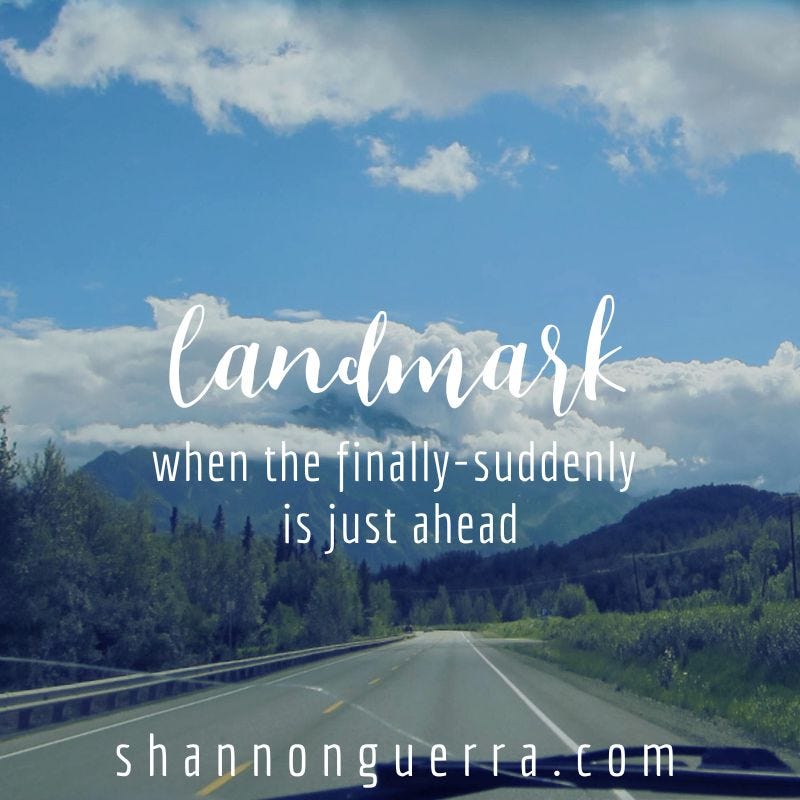
landmark: when the finally-suddenly is just ahead

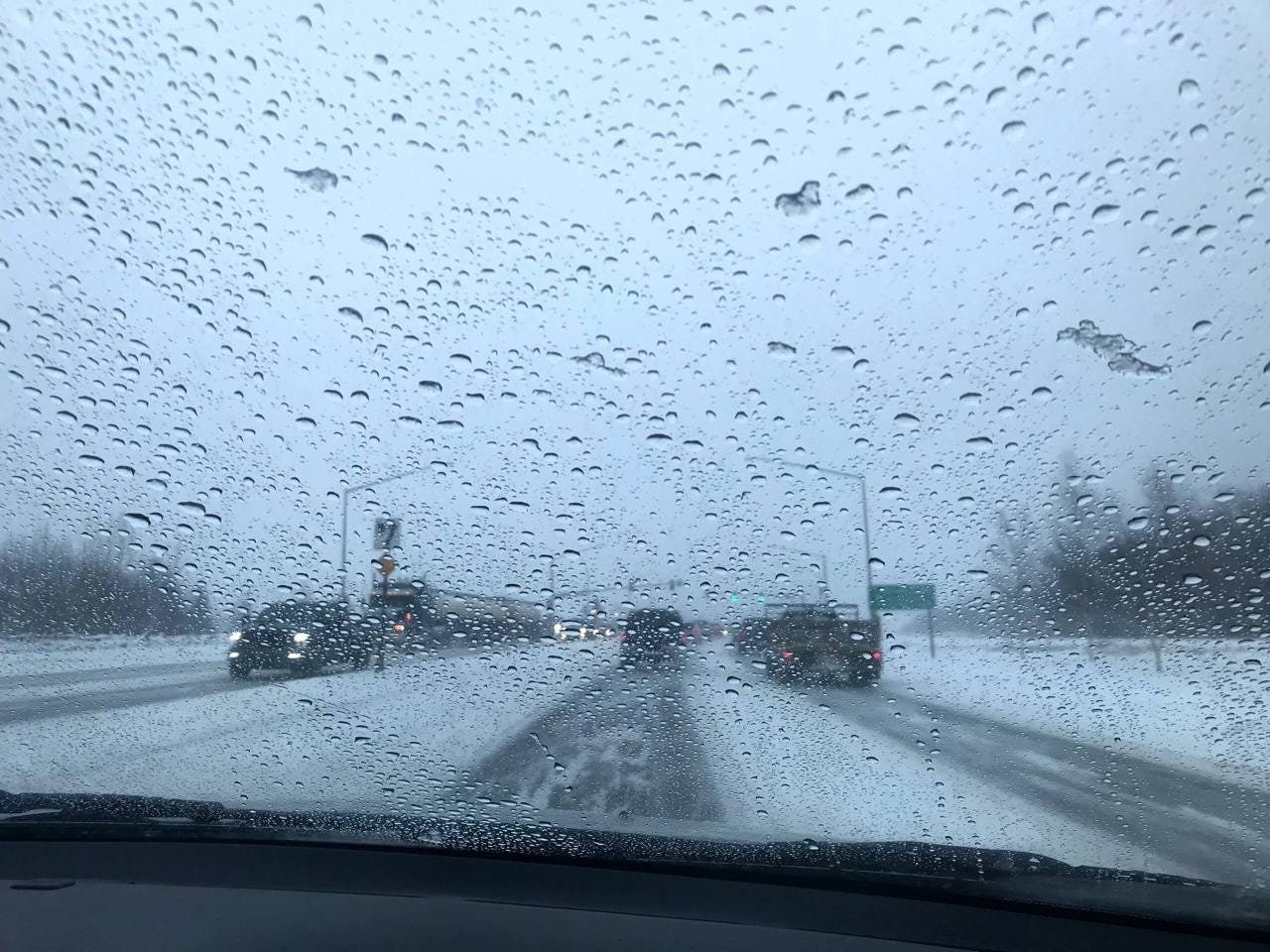
“Right there, that one.” Still going highway speed, the road to Grandma’s house rapidly approached on the passenger side.

Vin hit the brakes to slow down in time, and flicked the blinker. “I was looking for the sign…it’s not there anymore,” he said, making the turn.

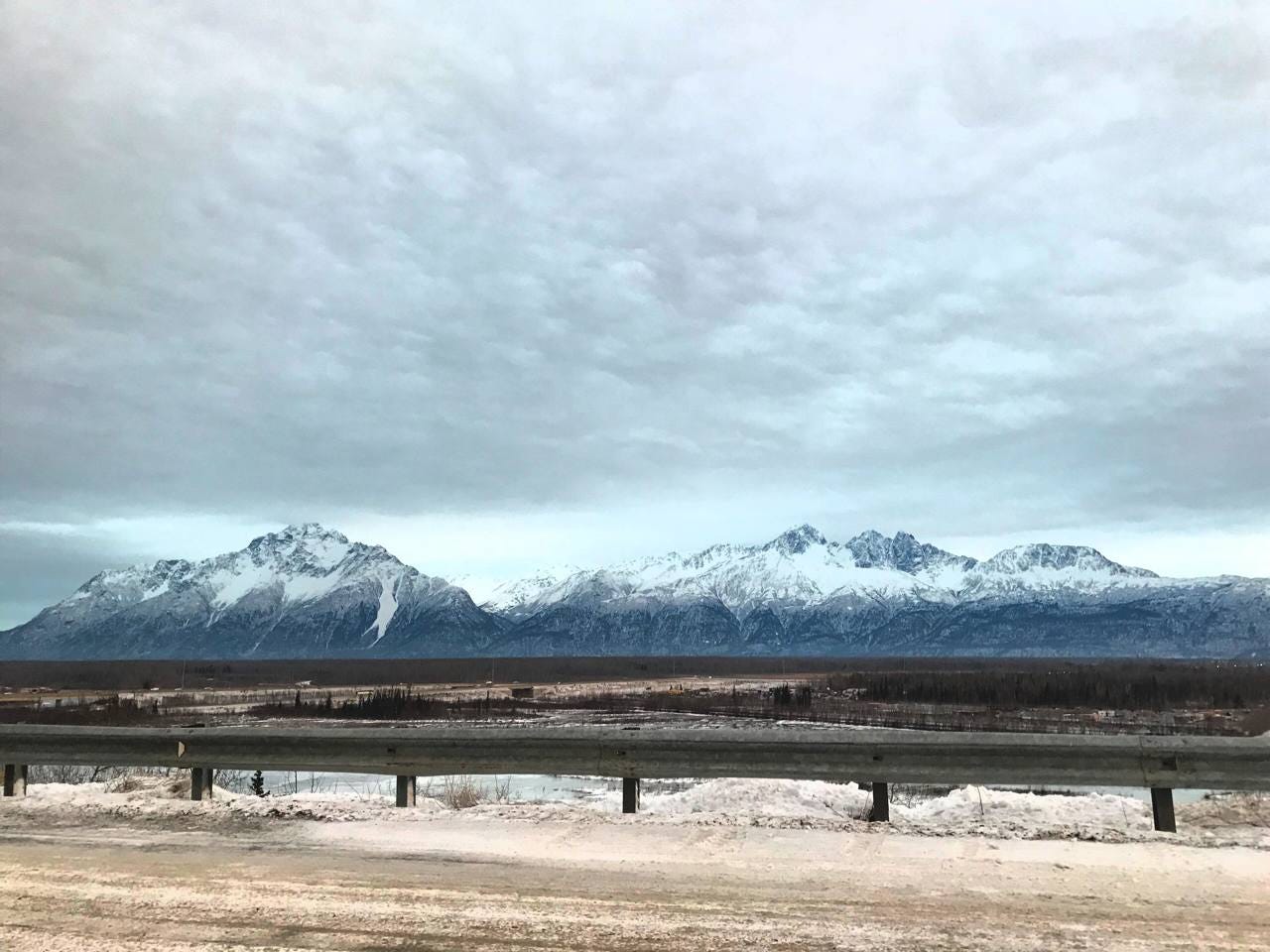
I never look for the street sign, so I didn’t even notice it was missing. Grinning, I pointed through the cracked windshield at the Butte looming in front of us.

“It’s right there. There’s your sign.”

landmark: when the finally-suddenly is just ahead

I don’t mean to brag. The man drives us everywhere and keeps a map in his head, while I almost took out an ornamental tree the last time I made a u-turn in the library parking lot.

But this road, I know. I’ve driven it so many times I could do it with my eyes shut…figuratively, of course.

I’ve been driving it more and more, too. The plan, for now, is to take it weekly because time is flying and Grandma is 94 and things that weren’t a concern a year ago are now quite different. A year adds miles to all of us.

Meanwhile, I’ve worked my way through Numbers but got hung up in chapter 33 because it is the end of the year and that chapter seems parallel to life right now. Because ready or not, change is here, and so many other markers we thought we’d never get to.

Promises fulfilled. Breakthroughs achieved. Milestones that were always in the distance, so far off we never really thought we’d see them up close – but here they are, rapidly looming larger and larger as the safe space between us shortens.

It’s finally, suddenly. And there are no brakes for slowing this down.

So let me tell you about Numbers 33, which summarizes the Israelites’ journey from Egypt to the Promised Land. They had been slaves, and went from bondage and captivity to freedom and fulfillment. You probably know this story almost as well as you know your own, so you know it wasn’t an easy-peasy, quick trip.

Just because you’re no longer a slave doesn’t mean you suddenly know how to live in freedom.

So the Israelites, like us, had a journey to make. And Numbers 33 gives us the landmarks:

They set out from Rameses in the first month, on the fifteenth day of the first month; on the day after the Passover the Israelites went out boldly in the sight of all the Egyptians…

– Numbers 33:3

During this journey, the Israelites wrestled with the same questions we do when we’re being honest: Is obedience worth it? Can we trust God? Are we who He really says we are, and can we really do what He tells us to?

Are we willing to go where He sends us?

Some of us have been promised something before, and it didn’t turn out the way we thought it would. It took too long, or maybe we confused the middle for the end. Maybe it was super messy, and came with trial or trauma. We feel like the promise burned us and we stopped trusting.

So now when we see a new landmark of promise and fulfillment looming ahead, we hit the brakes.

Dig in our heels.

Backpedal.

We do all the metaphors because we’ve (mis)learned that promises can also feel very much like threats.

You know the story of the twelve spies; this is exactly what ten of them did. The enemy wants us to see the worst case scenario and assume that all is lost.

We should, of course, be looking at Jesus, but problems (current or potential ones) are loud and flashy and demanding. They get in our face and try to become idols, because if they can command more of our attention than we give to Jesus…well, that’s what we’re worshiping, don’t you know.

But when we know the land, know the hand of God, and understand Romans 8:28 (and the rest of scripture), we know better: All is not lost. All is gain. There is nothing the enemy can do that, when surrendered to the Lord, cannot result in our gain.

When we understand that, it’s easier to stand our ground instead of shrinking back and looking for excuses to avoid what we’re called to do.

So, friend…in this season, what are you called to do?

We have to be free from fear. If we’re afraid of the landmark looming in the distance, we won’t confront it; we’ll be ruled by it, instead. But our wild exploits are rooted in our fearless movement forward.

Teach me your way, O Lord, and lead me on a level path because of my enemies.

Do not give me up to the will of my adversaries, for false witnesses have risen against me, and they are breathing out violence.

I believe that I shall see the goodness of the Lord in the land of the living.

– Psalm 27:11-13

Still though, so many things we thought were down the road are now right in front of us. We’re almost-finally-suddenly there, and so is the temptation to stall our engines or shrink back.

How many times have we sensed the “suddenly” coming, and we sabotaged it out of fear? Are we allowing God to be as big as He is – and trusting Him for all that He says – or are we making Him small and safe, in the terrain of our own choosing?

Maybe it will help to look back, and see how far we’ve come.

They set out from Pi-hahiroth, passed through the sea into the wilderness…

Look at what you’ve done: You faced the event you’d been dreading. You rose above fear and found a mantle of authority on the high ground. You confronted dishonor, you let go of betrayal, you forgave the one who repented, and you continued to love, even in new ways, the one who still doesn’t know how.

They set out from Marah and came to Elim…

You read this book and then that one, and you stumbled into a curriculum that was clearly the Lord’s design because it was not of your choosing. You learned so many lessons you never planned for, and you grew in deeper humility along with them.

They set out from Elim and camped by the Red Sea. They set out from the Red Sea and camped in the wilderness of Sin…

You had that hard conversation and made that brave confession, you learned that you could articulate those thoughts and feelings you’ve held onto for years, because you finally had a receptive audience. And you learned that the Lord is always receptive, too.

They set out from the wilderness of Sin and camped at Dophkah. They set out from Dophkah and camped at Alush.

You saved and invested, put the work in, milestone after milestone. Some of the markers are invisible to everyone but you – but you know how you carved out time to make way for a service that that no one else would see.

They set out from Alush and camped at Rephidim, where there was no water for the people to drink.

When you didn’t see the answer or the provision, you waited and it came. No, it didn’t look at all like you thought it would, but it came.

They set out from Rephidim and camped in the wilderness of Sinai.

You learned about balancing graciousness with firmness, and discerned between overlooking mistakes and confronting sin. Wisdom has taught you more about which concerns should be shared and which should stay private and prayed about. And you’ve gotten better at magnifying righteousness, instead of venting frustrations and giving the enemy the satisfaction of having volume added to his harassment.

Look at how you’ve grown, how far you’ve come. Look at what He’s done.

He reached down from on high; he took me;
he drew me out of mighty waters.
He delivered me from my strong enemy
and from those who hated me,
for they were too mighty for me.
They confronted me in the day of my calamity,
but the Lord was my support.
He brought me out into a broad place;
he delivered me because he delighted in me.

– Psalm 18:16-19

Can you believe it? Look back and see all the landmarks you’ve made it through, all the posts you held, all the places you stopped to build an altar and worship. A little wonder and amazement is called for.

He has been training us to take the land, drive out idolatry, expand the Kingdom, root out lies and deception, heal trauma, free the captives, and prepare the way of the Lord. We’ve learned that we have to start with the land in our own hearts first, because if we are still living as captives, we cannot free anyone else.

Toward the end of Numbers 33, there’s this little phrase in verse 54: “according to your ancestral tribes you shall inherit.” They, of course, were talking about boundaries of the land of each tribe, but there’s truth here for us, too.

According to your family culture (the way you hold your chargethe way you bear your calling, what you invest in, focus on, attend to, and cultivate)…you will inherit.

Our lives – and what our children will inherit from us – are wrapped up in these promises and how we follow Him into them.

We want each one of you to show the same diligence so as to realize the full assurance of hope to the very end, so that you may not become sluggish but imitators of those who through faith and patience inherit the promises.

– Hebrews 6:11-12

His goodness is the lay of the land – and you don’t need a sign if you’re familiar with the territory. You just need to know the landmarks.

He has been, and will continue to be, before and behind us.

He is leading, but He is also coming.

And He’s teaching us to prepare the way for it.

sing harmony: how we find our place amid change

When you go to the library, your book selections will reveal a bit of who you are…but only a bit.

When Vin and I went last week (sans kids, because it was our anniversary and we’re nerds), I got one book on quilting and another on leadership. Vin got books on history and true crime. And we both got a book to share (he gets credit for finding it, though) about toxic teachings in church culture that aren’t actually Biblical.

It’s not a full picture of either of us, but it’s a glimpse of this season. Also, it’s influenced by what the library offered: They had only two books by Dickens, three copies of Jane Austen, and zero (!) books by Wodehouse.

But I know what I like, regardless of whether or not the library carries it.

sing harmony: how we find our place amid change || Shannon Guerra @Copperlight Wood

So in this sense, the place I’m in doesn’t really define (or reveal) who I am at the core of things. What this temporary space offers doesn’t define (or change) what I actually like.

At the core of things, I love British lit, and already own most of those books. I’m currently in a quilting phase but I am a yarn junkie at heart. I love the Church, and am usually much more focused on teaching what is true rather than debunking what is not.

So a snapshot can reflect parts of us but it doesn’t really show our full identity. In spite of the change of location and what is offered at the library, I still am who I am.

And this is true of our changing relationships and seasons in life, too.

Some seasons (and relationships) in our lives are like a library that only holds books on true crime or psychology. Other seasons (and relationships) are like libraries full of parenting books, picture books, and hacks on removing crayon masterpieces from walls. They’re snapshots that shift and influence us, but they skew the focus on certain directions that do not define us forever.

We age, and our circumstances change. Our abilities grow and diminish, and sometimes we do not know how to respond to those changes. The temporary space we’re in is so different, we’re not sure what our role is in it anymore.

My grandma is almost 94 and recently, her already not-so-great hearing is so much worse. Added to the loss of vision and memory over the last several years, much of her life has totally changed. She’s had to adjust, and so have those of us who love her.

We used to talk often, used to call back and forth. She was curious about our present, and she told me about her past. I told her about our days and asked her about hers. Now, though, there’s so much less to our conversations because this is the season we’re in.

A few months ago I had some questions about my birth (which she attended) and she couldn’t remember any details. Maybe six months earlier, she would have. And maybe next month, she will again. But for now there’s a gap in places she used to be able to fill with light, and lines, and color.

Nowadays I’m the only one who initiates our phone calls, and I don’t do it often enough. It’s hard to have a heartfelt conversation while yelling into the phone so the other person can hear you, yes? But I call her because I know at the core, she is still there, and she needs to know she’s loved and remembered. And also, I call because I need her voice, and she needs to remember mine even though the last few times she hasn’t recognized it and I’ve had to tell her it was me.

During our most recent chat she said she’s feeling well, no problems, that she has no reason to complain. Then she lowered her voice and said, “That doesn’t mean that I don’t, though” – and there she is, the woman I know, the sassy grandma who is never in trouble but likes people to think she could cause some if she wanted to.

She asks if anything is new here and I tell her I’ve been trying to learn Greek, but it takes a few tries before she understands. Then she asks if I’ll teach her a few words next time I come over, and I might, though currently the most creative thing I can say is “I need a ticket” (and by that, I mean one to the opera or something, not one for speeding, thanks). She asks how we’ve been staying busy these days but she can’t understand what I’m saying no matter how many times I repeat it. So she moves on to wisdom and advice.

“Stop and rest, that’ll give you more years. I used to go-go-go all the time, and now I go…go…and…go…”

She pauses, and then asks, “Do you have plans for the summer?” Hopefully this is a blip; she knows her birthday in early November is coming in a couple weeks.

But I don’t know how to answer. I’m having a hard time finding books I can read on these shelves; this is a song I don’t know how to sing.

These relationships change for all sorts of reasons: age, estrangement, boundaries, busyness, distance. We don’t always know how to relate in the new seasons. I don’t know where everything is anymore; so many things I love seem to be missing. The song has changed and I can’t just go along because I still don’t know this tune yet.

“Do you read at all?” Grandma asks. “Do you have time to read?” And this is a face full of cold water. Don’t you even know me anymore? I wonder. I know she knows. Knew. She was a reader, too, before macular degeneration became part of our vocabulary. What does she remember of me, of us, of our family? Deep down, hopefully everything. But on the surface, on the phone, very little.

It is just a season. It is not who she is, or who I am. Who she is, is the woman who led me to Jesus, who took me to church, who taught me that the Bible doesn’t always actually say the things we think it does.

She led worship when I was growing up. She taught all of the kids how to sing Jesus Loves Me and so many other songs. When I went to school in Anchorage, she and my dad would drive an hour to come to my choir concerts even though I never had solos and only sang harmony.

Do you know that the little girl in messy blond braids who you used to take to church every other weekend now teaches others about Jesus? Did you know that the seeds you planted over forty years ago bloomed into her full-time mission?

I can’t tell her that, yelling into the phone, her not hearing me.

But who taught me to sing Deep and Wide? She did.

There are so many songs we don’t know how to sing. Kids grow up and move out, and the tune changes. They learn new songs we’ve never heard and don’t know the lyrics to. They also learn songs they think we’re clueless about, even though we’ve been singing them for decades.

But in spite of changes, can we still remember who we are, and who they are? Regardless of how people treat us, or how they change, or how we change, or the ways the walls are different around us, can we still remember our core – who we are, who they are, Who we have surrendered to? Do we remember that we are the temple, and our hearts are the sacred place where worship is always occurring?

Because if we know that, then the temporary place we’re in doesn’t define (or redefine) us. When we know how music works, we don’t have to know the tune, or even the lyrics. We can sing harmony, instead.

I waited patiently for the Lord; he inclined to me and heard my cry.
He drew me up from the desolate pit, out of the miry bog,
and set my feet upon a rock, making my steps secure.

He put a new song in my mouth, a song of praise to our God.
Many will see and fear and put their trust in the Lord.

Happy are those who make the Lord their trust.

– Psalm 40:1-4a

That person who distanced themselves and makes condescending judgments from their newly purchased high horse…can you see through their posturing? Can you recognize the voice that’s a touch louder than normal, and remember that it’s because they’re trying to convince themselves and others of things they don’t quite yet fully believe, and pray them toward integrity?

That one who needs healing, protection, wisdom, and maturity…can we love them through these changes, see past the braggadocio, and pray them through this season so they come out with fewer regrets on the other side of it?

That person who seems closed off and unreachable…can you see the heart that’s really there, the one that’s wounded and wary? The one that bottles up and then explodes because they still haven’t learned to recognize feelings and release pressure in healthy moderation? We can refuse to be cowed by the spiky exterior because the spikes aren’t about us, and we can press deeper than the shallow small talk, and risk baring a wound of our own that they might relate to.

What about that loved one who is singing away with everyone in their new crowd, seemingly reveling in how they’ve left you out? They’ve run hot and cold, and their song keeps changing mid-verse. You keep stumbling in, not sure what to do next. Should I hug them? Or will they bristle? Will they resent it if I don’t? I don’t know the words to this new song, they passed out the lyrics before I got here.

These are only glimpses of who they are. This temporary space they’re in does not define them, or us. We know who we are, whether or not we like the books on the shelves or the tune that others are singing.

sing harmony: how we find our place amid change || Shannon Guerra @Copperlight Wood
(In Galway with Grandma, March 2003)

And if you know music, you know what a rest is. You know that at certain times there’s an interval of silence when you’re not supposed to sing or play. Stopping and resting will give you more years, Grandma said.

So sometimes we need to stop for a while. You don’t have to share your song with someone who can’t stop criticizing your choice of music. We cannot have duets with people whose proximity is so corrosive you have to put a stop to it, but we can keep praying for their physical and emotional healing.

Beloved, do you know that we contend daily for your spiritual freedom, that you would encounter God and know His mighty love in every area of your life? Just because we stopped singing with someone doesn’t mean we lost our songs. They’re still there in the middle of you and me, wanting the best even for those who only seem to notice the worst.

But thanks be to God, who in Christ always leads us in triumphal procession and through us spreads in every place the fragrance that comes from knowing him.

For we are the aroma of Christ to God among those who are being saved and among those who are perishing: to the one group a fragrance from death to death, to the other a fragrance from life to life. Who is qualified for these things? For we are not peddlers of God’s word like so many, but as persons of sincerity, as persons sent from God, we are speaking in Christ before God.

– 2 Corinthians 2:14-17

We know that the Lord does not change His tune. He doesn’t run hot and cold in affection and indifference, and pull the rug out from under us. We’re not His best friend one day, His punching bag the next, and then snubbed the following week.

He always wants our presence. He is always leading us in triumph, in wisdom, in joy, regardless of the people we’re around, the circumstances we’re dealing with, or the temporary spaces we’re in. This is how the music works.


But I trusted in your steadfast love;
my heart shall rejoice in your salvation.
I will sing to the Lord
because he has dealt bountifully with me.

– Psalm 13:5-6


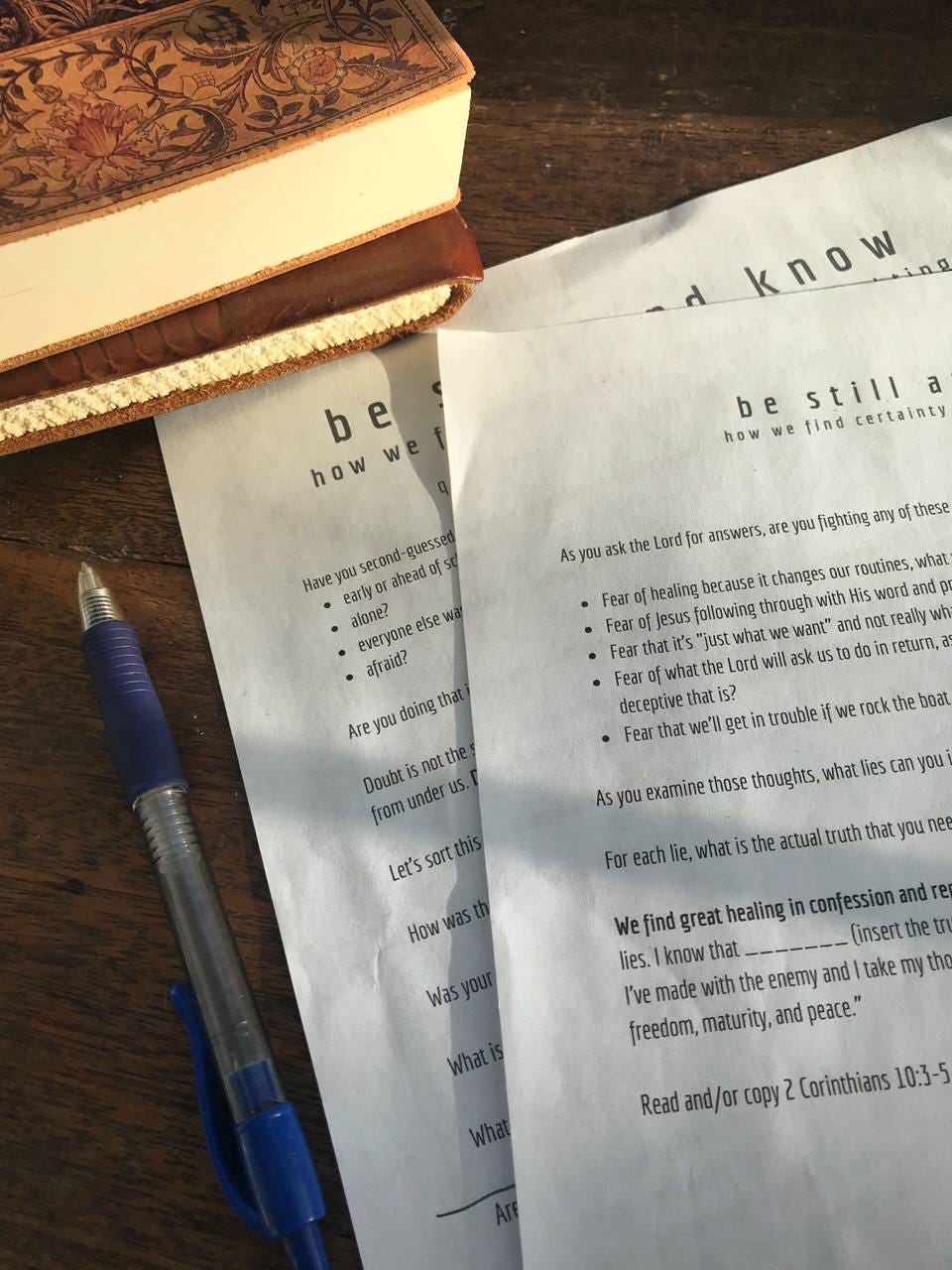
P.S. New resources! Looking for a new study for your small group, life group, or personal use? I’ve got a page of free downloads for you.

Print them, share them, meet with a few friends at the coffee shop or in your living room, and move deeper into wholeness, maturity, and your relationship with Jesus. You can also find them under the “resources” tab on our website, and there’s no sign up necessary; just click.

Also — got a favorite post you’d like to be expanded into a study, so you can go deeper on that topic? Message me and let me know.

rebuild: how we heal, protect, and recover

We never need someone’s permission to do the right thing. Seems like that should be obvious, but apathy and cowardice and destruction hide behind many doors, and “I’m not allowed to” is sometimes one of them.

rebuild: how we heal, protect, and recover | Shannon Guerra

Years ago when the Matanuska River was flooding its banks and the local government was dinking around with bureaucratic red tape, we watched a house a few doors down from my grandma’s tip into the river as the water ate up the ground underneath it and then proceeded to slowly swallow the house as it floated toward the Knik Arm.

It was 1991. The edge of the river moved closer to her house every day, and if nothing happened by the time it got to her property line it would be too late, because that was a mere hundred feet from the foundation of her house. So while those “in power” did nothing (and does that mean they’re really in power at all?) my dad and uncles dropped concrete slabs down the embankment to shore up the side, deterring the rapid erosion. They saved her house, and probably several others downriver, before a series of dykes were installed to keep the Matanuska in check.

So now it’s 33 years later, and in another rural part of the country we have a much bigger problem:

People are stranded in disaster areas without food, water, or fuel, and institutions and government blowhards who are supposed to help are confiscating supplies, and clearly up to something else.

[Warning: Many of these videos I’ve linked have language and other details you will not want to play around your kids. But adults need to hear it – we’re not sugar; we won’t melt.]

Citizens try to help but are blocked by government officials and threatened with arrest. Government resources are grounded instead of helping…but that doesn’t stop them from taking credit for what civilians are doing on their own.

People were dying as a senile “president” flew over, blocking air traffic from those trying to deliver supplies, undoubtedly causing more deaths from the delay.

If all this sounds unbelievable to you and you think things are fine, you need to turn off your TV and stop listening to people who are paid to lie to you, and start listening to real people. Like here. And here. And here.

A government who sent billions of dollars across the world to foreign nations now says there’s nothing left to give to citizens, but then releases a meager $750 via the flick of a middle finger to Americans who’ve lost everything.

What is happening?

If you were paying attention to what happened in Maui, you probably already know.

So…abhorrent, dire conditions in our own country. I sit here, far away in Southcentral Alaska, at my desk and on the couch and at the kitchen table with my family, remote from it all and yet hyperaware that Alaska has its own vulnerabilities and enemies, foreign and domestic. Wherever you are in America, you do, too.

But what can we do?

With such need, and corruption, and distance, what can we do that goes beyond mailing a check? How do we help, how do we resist, and how do we protect our own communities?

And I looked and arose and said to the nobles and to the officials and to the rest of the people, “Do not be afraid of them. Remember the Lord, who is great and awesome, and fight for your brothers, your sons, your daughters, your wives, and your homes.”

– Nehemiah 4:14

We create a life out of slow, single days, tiny beads on a string, and one event can wipe it all out. I look around, and everything I do is slow work: Growing food is slow, raising poultry is slow, writing is slow. Parenting and teaching and healing is slow. Supporting small businesses and strengthening families is slow.

It is easy to get bogged down looking too close at my own inabilities, and despair. The needs are immediate, relief needed right now. And we don’t know what tomorrow will bring. But we must not capitulate to the enemy’s ploy to make us feel powerless and helpless.

Prayer is fast. Miracles are fast, and they’re needed right now.

Prayer reaches across the distance and touches people at the speed of thought, bringing supernatural protection and favor and wisdom and guidance. We don’t know the details and most of us can’t get there, but God does and can, and is there.

Prayer doesn’t care about the mocking, scoffing, spitting, disbelieving. Let them berate and see how much peace they find from their ignorant faithlessness. It doesn’t care about permission or blowhards or red tape; it soars right over, blasts right through, the agreement with God’s goodness releasing His power to change situations, to create something out of nothing, to lead those who don’t know where to go or where to look, to draw water from the rock.

So there’s that, and it’s definitely something.

I had a long conversation with one of our kids about all these events, and why we do what we do – why we shop certain places and avoid others, why we spend time learning and teaching things that aren’t on a curriculum. You can’t go wrong in learning about prayer, healing, security, and food, I told her. All we can do is the thing God’s telling us to right now, today, in this moment.

For example, when you learn about healing, you learn that there are four stages to it: hemostasis (stopping the bleeding), inflammation (scabbing over), rebuilding, and strengthening.

What strikes me about this is that none of it is done in isolation: At first, the closest blood cells come together to clot and protect the wound. But then, white blood cells and oxygen come in. Then red blood cells come in, helping to rebuild new tissue.

We have a huge gash in our Southeastern states right now, and the process of stopping the bleeding, clotting, and protection is in full force thanks to those who didn’t wait for permission to do the right thing. Meanwhile, those of us holding down the fort in other areas do well to strengthen our immediate surroundings, to fight against the attempts to obliterate our communities and culture. We don’t know when our own tissue could be injured, or our red blood cells called in to reinforce healing needed nearby.

When all else fails and you are overwhelmed, unsure of what to do or prioritize, look at the core strengthening things. What foundations need shored up? What relationship needs some extra time, or just an extra hug? What small task is going to bolster your day tomorrow? Do you need an extra hour of sleep, an extra glass of water? We can get so focused on the big things that we forget the little things until they turn into big things we could’ve prevented.

And the effect of righteousness will be peace, and the result of righteousness, quietness and trust forever. My people will abide in a peaceful habitation, in secure dwellings, and in quiet resting places.

— Isaiah 32:17-18

There are so many voices out there. Many of them are good and true. But we still need to be quiet, to stop scrolling for a while, and listen for Him to speak specifically to us, just to us, in the quiet.

It’s important to starve the voices that aren’t true. We have to prioritize who we give the microphone to in our lives. We can turn the volume down on the excess noise in our society by trimming the amount of time we scroll.

We can’t go wrong in reaching out, making stronger connections, hugging the prickly kid, texting the distant kid, feeding more broth and tea to the sick kid. We can read good books, pray for our neighbors, grow and cook real food, memorize Scripture, learn new skills. We can repair rather than replace, create more and consume less. We can smile and talk with the person in line at the grocery store or post office. We can filter our media consumption, and prioritize what gives life, beauty, joy, and wisdom.

We will probably never regret doing things like deep cleaning our kitchen, taking flowers to a friend, or spending an extra few minutes talking with our kids at bedtime.

These are the things that bring oxygen, that create healing, that prevent injury and sickness, that declare to the world, We are building Kingdom culture and we have no intention of stopping. Where it’s damaged and hurting, we will rebuild and reinforce and strengthen, and as many times as it is wounded, we will keep rebuilding, and won’t wait for paperwork to go through or for bureaucrats to finish dinking around or for a government blowhard to give us the green light.

We are Kingdom people; we live in the green light, and we will keep moving forward.

We don’t need anyone’s permission to love our neighbor. We don’t need the government’s permission to protect our families or build and strengthen our culture. We just need to do it.