Middle of June.Leaves are full on the trees, the sky is blue, and the deck is covered in pots of dirt with various green things sprouting. Unless you know your plants, most of them aren’t even identifiable yet.
So when my best buddy in the States sent me photos of her glorious peonies in full bloom, it was a sign of things to come. Hers look like this:
And ours currently look like this:
Do you SEE how gorgeous ours are?
Of course not. You can’t even tell what color they’ll be. (Light pink. Here.)
But it’s not time for them yet, because this is Alaska. Spring lasts for about two weeks, summer gets a late start, and peonies don’t bloom here until July. If you have anything impressive in your garden this early, you probably bought starts from a nursery.
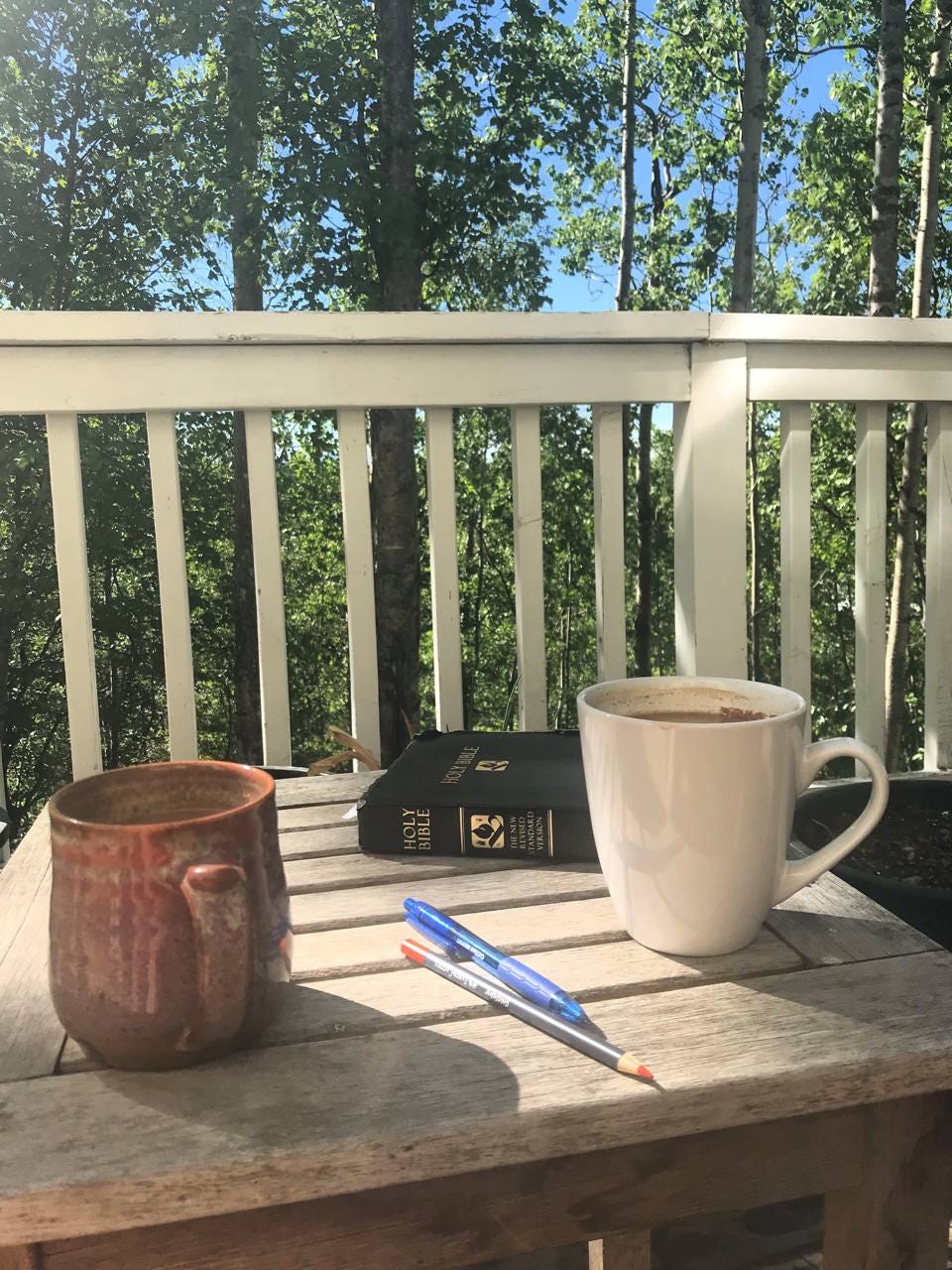
I shared this photo online last week with a scripture verse, and if you’ve read about some odd reactions I’ve gotten to those, let me assure you that at least the comment I got on this one was probably well meaning and wasn’t from a religious weirdo (I don’t think so, at least):
The comment was, “I feel sorry for your houseplant.”
My initial thought was, What houseplant? This is a photo of my desk. But then I looked again, and oh yes, there’s that little snake plant on the floor that has taken forever to grow from cuttings I got from a friend.
It does look sort of pathetic in the photo, but it wasn’t the focus of the post. In reality it looks almost as pathetic has five shoots that have grown up from the dirt, and only two of them show in the picture.
This plant is a slow grower and doesn’t like full sun. So it sits in the corner by my desk and quietly endures judgement and pity from strangers online, listening to Einaudi with me while I write.
But it’s doing its thing; it doesn’t need anyone’s pity.
It doesn’t edit, doesn’t create graphics, doesn’t check email or answer phone calls for me. But it’s not meant to do any of those things. It’s meant to sit there and grow, and there’s no deadline or competition.
It is doing what it’s meant to do, and minding its own business.
Or, can we rephrase that, and say it’s obeying its calling? Because it is.
Out of my distress I called on the Lord; the Lord answered me and set me in a broad place. With the Lord on my side I do not fear. What can mortals do to me? The Lord is on my side to help me; I shall look in triumph on those who hate me. It is better to take refuge in the Lord than to put confidence in mortals.
— Psalm 118:5-8
Lots of things (and people) look funny while they’re growing, and deal with the ignorant judgment from others who only take a quick look and have no idea what the full story is.
For the grace of God has appeared, bringing salvation to all, training us to renounce impiety and worldly passions and in the present age to live lives that are self-controlled, upright, and godly, while we wait for the blessed hope and the manifestation of the glory of our great God and Savior, Jesus Christ.
— Titus 2:11-13
It reminded me of a conversation I had at church last weekend, when someone asked me if I ever wondered about what other people thought of my special needs kids, and why they’re not healed.
And yeah, I have thought that. Vince and I have been in and led prayer ministry for years, and I have no doubt people have looked at us and wondered if we were really qualified to lead or minister or pray for healing because some of our kids’ issues have been super obvious.
But what’s not obvious is where our kids came from, or what they’ve been through, or how far they’ve come. In our local church, only two other people have seen our journey from the beginning.
How many times have we judged others when we had no idea how many hurdles they’ve already overcome?
How many times have we judged ourselves or others for not doing things that we’re not even meant to do? For not looking like everyone else? For not having the same timeline? For having a different starting line and growing season?
He it is who gave himself for us that he might redeem us from all iniquity and purify for himself a people of his own who are zealous for good deeds.
— Titus 2:14
We are not all organic heirloom seeds, planted in perfect loamy soil with a long head start in spring, watered on a scheduled timer.
Some of us are just doing the best we can in the clay and the climate we were planted in. We don’t have as much time, and halfway through the year it still looks like we just started.
But if you are obeying in that, it is enough.
We have this horrible habit of setting expectations and rushing timelines that have nothing to do with what God calls us to.
There are glad songs of victory in the tents of the righteous: “The right hand of the Lord does valiantly.”
— Psalm 118:15
So here, a word for the one who is looking at their progress and wondering why there’s still so little to show for it:
Your early growth doesn’t define your success. Don’t let someone else’s greenhouse beginning diminish your efforts from seed.
It’s not a competition until we try to make it one, and when we do, everyone loses. It’s better to just refuse that game, mind our own business, and obey in our own calling.
Your friend’s Pacific Northwest climate doesn’t diminish your Alaskan rate of growth. So don’t judge your June growth by your August expectations; you’ll know what color you are soon enough.
You are allowed to be the late bloomer. The dark horse. The sleeper whom no one expects, and then wakes with a roar.
Before we worked from home together, Vin commuted to Anchorage and was gone about 60 hours a week. For most of those years he drove a small pickup. It’s Alaska; everyone has a pickup here.
Handy things they are, except for when it comes to highway mileage. A pickup has a tailgate and a bed, and unless you have a canopy or cover on it – we didn’t – you get drag.
Resistance. Opposition to forward motion. You spend more gas trying to get where you’re going just because that truck bed and tailgate are cupping the wind at highway speed.
For years, people told us we should get a commuter car. We knew we should, too, but buying a new vehicle and selling an old one is a pain. Those were desperate days, too much going on, who needs one more thing to do?
So we avoided the change and stuck with the little pickup until January of 2014, when Vin rolled it on the highway during a snowstorm, totaling it.
Then we had no choice: A commuter car it was. And you know what we started saving in gas?
Five hundred dollars a month.
We knew it would make a difference, but we had no idea it was costing us that much. What could we have done with an extra $6000 a year, for those six years?
What else is our avoidance (stubbornness, laziness, resistance, denial, or any other drag) costing us?
Here’s the big question that might save you a ton of time, money, emotional investment, and other resources:
What am I ignoring or putting off that will actually be for my overwhelming good?
Sometimes lost things are found when we let go.
Our days are no longer desperate like they were then. Or, maybe they are, but in different ways: The kids are calmer, but our scope is broader, there’s no steady paycheck, and our schedule is often out the window because our work is way different and almost always changing.
Those days make me wonder if I still am who I was, or if I lost something. Did I drop my calling? Why is it so hard to shift back and forth sometimes? Am I walking in neglect or disobedience? Or am I just tired? (Stupid question. Don’t answer that.)
A single day of feeling supremely off kilter can make me wonder all those things, because I am fragile and human.
That’s the wrong kind of wonder to have. It’s drag, and it’s far more expensive than commuting to Anchorage in a little pickup, because if not caught it leads to brooding, which in turn often leads to all sorts of leading questions and bad conclusions.
The cost is high because it’s our identity and vision at stake.
So here, too, is where we ask: What am I ignoring or putting off that will actually be for my overwhelming good?
And in this case, the answer (for me, at least) is pretty much the same every time: Abiding. 1
If I were abiding in this situation, I wouldn’t be doing the wrong kind of wondering. I wouldn’t be questioning my calling or ability, wondering if I lost it or if it was just a long season that’s over.
I’d have real answers, instead. I’d have peace and grace for the day, instead of anxiety and discouragement.
When I finally confront the issue head on, rather than avoiding it for days on end, striving and struggling needlessly in angst, it takes a whopping five seconds of concentrated abiding to realize what’s going on.
Be honest, Shannon. Ask the question. Put it into words and confess it.
You haven’t dropped or lost or neglected anything, Love. But you are not always meant to tell and translate. You also need to soak and receive.
Oh. Duh. Well, that sounds so obvious.
But I’ve gotten so used to the feeling of pressure that I didn’t even recognize it. This happens with all sorts of mindsets, and they become like refrigerator noise in the background of our lives that we don’t even hear anymore.
So listen: What is the noise you’ve been ignoring, or that you’ve gotten used to? We can’t deal with it until we identify it.
When I let go of the pressure to write, that’s often when a torrent of words rush out. Onto the screen, in my phone memo, on any scrap of paper I can find.
Like I said earlier, sometimes lost things are found when we let go.
Oh, that’s where I am. That’s the me that thrives the way You made me to – because I finally looked for where You are in this. I missed the forest for the trees, but You were here all along.
To be fair to myself and honest with you, I can abide in all sorts of things while avoiding the main issue I really need to talk to the Lord about.
I think it’s a common ploy of intercessors; we can procrastinate and distract ourselves by praying for a million other things, and still feel pretty good about our abiding. A friend of ours who led worship for years said it’s the same on that side of the coin, too: If he didn’t want to deal with something, he would worship, instead.
Isn’t it funny how we can use righteous things to avoid becoming more righteous?
And isn’t God gracious to still meet us in our avoidance, and wait for our honesty? Even our ability to face things is grace from Him.
It would be nice to have more grace and peace, though, and get back on track faster.
May grace and peace be yours in abundance in the knowledge of God and of Jesus our Lord.
– 2 Peter 1:2
We tend to overuse and gloss over those terms. What do they really mean in the messy situations we’re dealing with?
Grace and peace look like solutions, resolution, revelation, and certainty. They look like security in our identity, steadiness in our calling, and boldness in our obedience.
May those things be yours and mine in abundance. And may we cooperate with receiving them, because God’s generally not going to force them on us while we’re ignoring the issue He wants to address.
To defeat the drag and make forward progress, we’ll need to sell the truck, make the move, call the person, spend the money, ask the question, admit our weakness, acknowledge the problem, confess the sin, set the boundary, etcetera, etcetera. It could be anything. It’s probably on your mind as you’re reading this.
Anyway, whatever it is, if we’re not willing to do it because we’d rather feel the drag against our tailgate (ahem), then He’s generally not going to force that particular answer upon us.
Good news, though: He’s made us for the answer. He knows how weak, exhausted, angry, wounded, confused, overwhelmed, or whatever we are that seems like it’s holding us back.
Seriously, He knows how whatever you are. And He did all the heavy lifting to make us like Him:
His divine power has given us everything needed for life and godliness, through the knowledge of him who called us by his own glory and excellence.
Thus he has given us, through these things, his precious and very great promises, so that through them you may escape from the corruption that is in the world because of lust and may become participants of the divine nature.
– 2 Peter 1:3-4
You and I cannot participate in the divine nature if we neglect to abide. Abiding is the participation: This is how we know, hear, act, and become more like Him.
It’s how Peter, who wrote those words, went from being an impulsive loudmouth you probably wouldn’t want speaking at your funeral to becoming an older and wiser heavyweight who could handle the spotlight. Both versions were forces to be reckoned with, but only one was fully surrendered and thus able to lead others in that same transformation.
So we don’t want to waste gas, too focused on the problem to do anything to actually solve it.
If we’re putting off abiding – or any other prompting of the Holy Spirit – we’re not changing anything for the better.
Such a bummer. I’m so sorry.
What can we do, then?
First, if this rings a bell, we need to acknowledge our avoidance and confess it. It’s not a huge, drawn out thing. It’s a reality check, and it’s instant: “Yep, I’ve been doing that.”
Then there are several things we can do. But to work smarter and not harder, the best first thing is to ask God: What do I need to do now? And then do it.
I know, the best time to do it would’ve been a long time ago. But the next best time is now.
And one more question to ask Him: How do You want me to see this situation? Because we want to see it the way He does. He’s not discouraged or dismayed over this. He’s not overwhelmed, overwrought, or doing the wrong kind of wondering.
When we’re looking at Him and seeing things the way He does, we see possibilities instead of limits. We stop partnering with fear, agreeing with the enemy, making blanket statements and accusations and assumptions. We stop doing the things that make it worse, and start doing the things that make it better.
Bemoaning that the enemy is winning in different areas or how we feel like we are losing in other areas is a poor strategy for defeating him. It’s a total drag, wasting our resources.
But quick cooperation with His promptings brings momentum. Obedience to God is spiritual warfare. And this is how we win.
Sign up here to get these posts to your inbox for free. (Upgrading to a paid subscription is a huge support to our ministry, thank you!) You can read more about what we do here.
P.S. We’ve had a big change at our house, and we’ve also got a big prayer and provision need. Here’s our monthly update.
P.P.S. Our pastor gave a great message here that relates to this topic (starts at 1:09). Bonus: Vin is in a couple of dangerousaggressive super awkward sermon illustrations. 😅
Often for me, writing IS abiding. Journaling, praying, all the thoughts going on paper or screen…I’m talking to and with Him more than anyone else. But after years of writing as vocation and ministry, writing is also work, and there’s the struggle. Maybe there’s a post on that coming soon. ↩︎
Change is risk, movement is risk. But staying still and not doing anything is also a risk. For some deceptive reason, it just doesn’t feel like it because it’s so passive.
Our family has been in a significant transition for a few months – or more accurately, years – but most of the recent change has actually been in our minds: how we view and communicate what we do. Most of the physical, active changes already happened; it just took us a while to realize it. It was gradual and unintentional, hiding in plain sight.
“What would it look like for you to shift toward full time ministry? What would change?” one of our pastors asked, sitting with his wife on the couch across from us.
“Well, this week,” I answered, “it looks like taking Thursday off to help one of our families paint before they move…and not feeling guilty about it because we won’t be at the desk.” That’s the biggie.
We, like you, are pulled in all kinds of directions, and we fight feeling like we should be in all the places at once. Simultaneously, some of us also fight the urge to hide in our blanket fort all day where it’s safe, because the world out there can be doodlywhack.
My child, do not let these escape from your sight: keep sound wisdom and prudence, and they will be life for your soul and adornment for your neck.
Then you will walk on your way securely, and your foot will not stumble.
– Proverbs 3:21-23
Anyway, that was the plan for Thursday, but then we learned another friend in our group was diagnosed with pneumonia. And it’s been nine years, but I remember what it was like to be a nursing mama with pneumonia through almost the entire summer of 2016, with the feeling of “I can’t even” pervading everything.
I was already making a meal for the painting crew and it was no big deal to make a little more, just as it was no big deal to just split up for the first part of the day and reconvene later.
So that was the New Revised Plan: I’d take the girls to drop off goodies, Vin would take the boys straight to our other friends’ house to help prep for painting. Two vehicles, two destinations, and the girls and I would be back to join them by early afternoon.
Buuut…you know where this is going, right?
Of course you do. If everything went according to plan, why would I be telling you this?
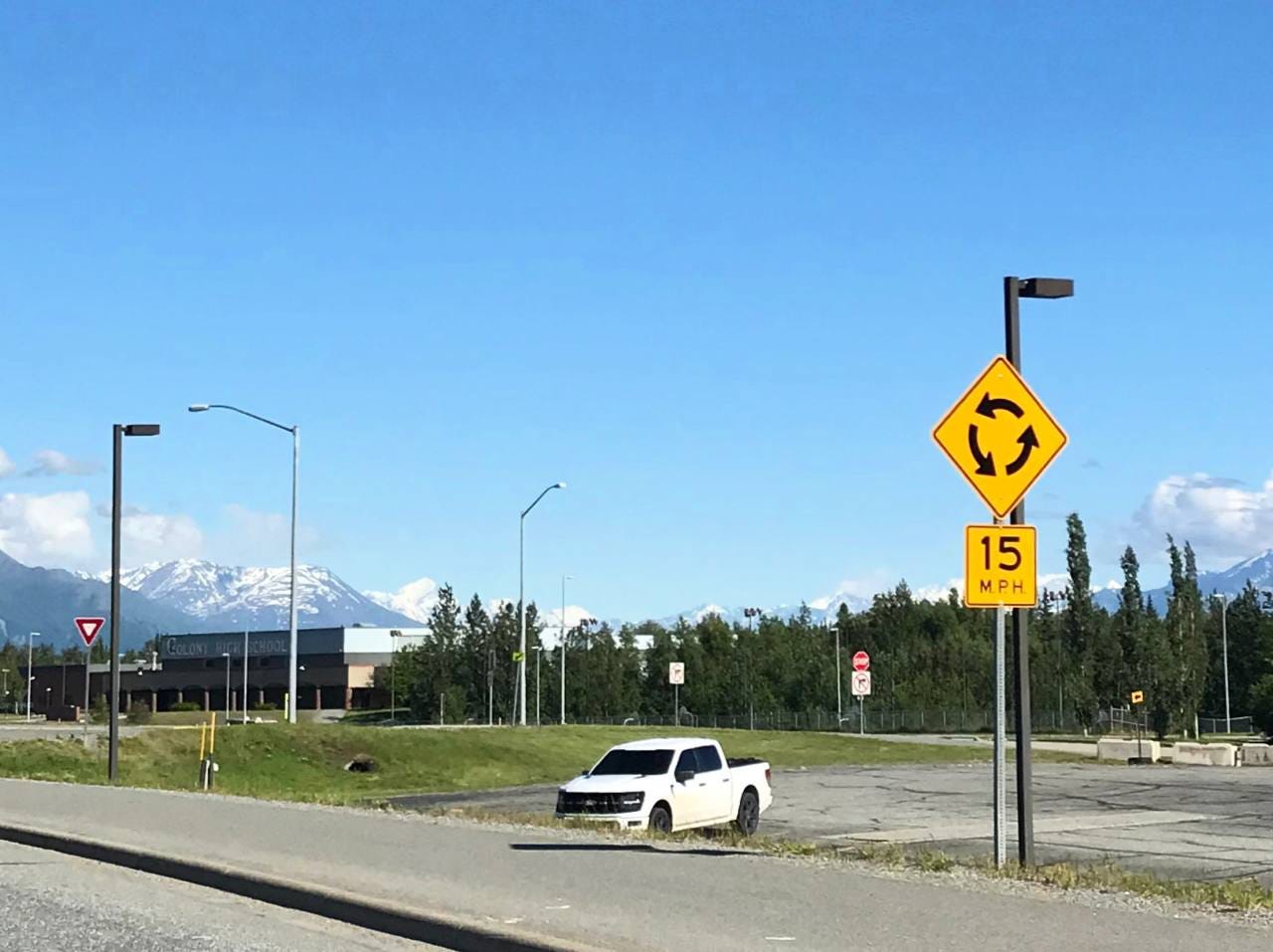
The local lighting store tried to warn us on the drive out:
It started fine, though. Our friend who had pneumonia lives on the other side of the valley, so we had a drive ahead of us: through Wasilla, through Palmer, up the highway toward Sutton. It was a beautiful day for it, though.
It did cross my mind that this was quite the expedition to make just to deliver a small meal and a few other supplies. Not cost effective, not time efficient. And we think to ourselves, Will it really matter, anyway? Do these efforts make a difference?
It is such a long way to go, what if something goes wrong? We so often decline to do the right thing because self-protection mode is our default…until we change it.
The wind was against them now, and Piglet’s ears streamed behind him like banners as he fought his way along…to listen, a little nervously, to the roar of the gale among the treetops.
“Supposing a tree fell down, Pooh, when we were underneath it?”
“Supposing it didn’t,” said Pooh after careful thought.
– A.A. Milne, The House at Pooh Corner
Doing nothing is as much of a risk as doing something. And it was so clear when we found out our friend was sick that I was supposed to take her these things. To see her, to pray for her, to tell her what I knew, to deliver right to her home.
As we left our driveway, we prayed like always for a safe drive, no accidents, no injuries, a productive day, all the things.
All the things we thought of, at least.
I didn’t think to pray against car trouble. Or more specifically, to intercede for the car’s gas pedal. But I’m getting ahead of myself.
We arrived without incident. I delivered the package of goodies, prayed for my friend, patted the cute dog on the head, smiled at the kids. Restarted the car, turned around, went down the driveway, flicked on the right blinker. Turned back onto the highway.
Pressed the gas, and…twang, the pedal hit the floor under my foot. The car immediately decelerated, not even having reached 20 miles per hour.
I coasted into the grassy shoulder in front of the next driveway.
Assess the situation: Our car was stuck on the edge of the Glenn highway, fifty minutes from home, and I could not find the &*%$# switch for the hazard lights anywhere.
On the positive side, we hadn’t gotten far, and it was the gas pedal, not the brakes. There was no one right behind who had to swerve to miss us. It was only a two minute walk back to my friend’s house, and there was a paved path right behind our car, so we wouldn’t need to walk in the ditch or too close to the road.
So that was the New Revised Updated Plan: Grab our things, walk back to our friend’s house, call Vince, figure out what to do.
Let me interrupt here for a brief aside: Do you know that everything we do carries risk?
Sitting here and writing to you is a risk, an act of faith. I don’t know if these paragraphs will go anywhere. As I write them, I don’t know if they’ll come together into something coherent, or end up in the purgatory of my notes file. If it does come together, I don’t know who or how many the message will resonate with. I don’t know if people will misunderstand or find offense or leave nasty comments.
Every single time, I never know.
But the more I do it, the more I know that He moves through it in ways I can and can’t see. So I’m typing away here on this rabbit trail, trusting that it’s either going to be used to grow into an article, or to grow me.
And the same thing is true for whatever you are doing in quiet, steady obedience.
Everything we do is a risk. Everything we don’t do is also a risk. So we might as well be bold and free, and obey the Holy Spirit’s promptings.
Back at my friend’s house, I made and received about 58 phone calls and texts: To and from Vin, my dad, my cousin, AAA, and the towing company.
Do we need someone to come get us? Yes. But also, we need to be here when the car is towed. How long will that take? About two hours. Also, my name isn’t on the account, so can my husband be there when the tow truck driver arrives? No? Well, I should think about getting myself and my daughters an account, so the next time this happens I won’t have to deal with all of this. Right, well, since neither of them drive and I’m a little preoccupied at the moment I’m disinclined to fall for the marketing shtick right now but thanks so much anyway, buhbye.
So now we had a New Revised Updated And Expanded Plan: Wait for the tow truck, ride back with it to Wasilla, get picked up by Vin at the car shop, resume our originally scheduled plan, better late than never.
What did we do the whole time, besides send and receive 58 texts and phone calls? We smiled at the baby. Talked about pneumonia, and how to prevent cracked ribs from violent coughing. Talked about books, and woodstoves, and our families. And Reagan, who has always been afraid of anything on four feet, had some exposure therapy to one of the mellowest dogs ever.
Our self-protection mode keeps us back from so much. Obedience and freedom both require the same thing: Allowing our lives to overlap, rather than staying safe in our own bubble (or blanket fort) where we think bad things can’t happen, where people can’t touch us, and where we can’t accidentally hurt others.
Where we won’t get stranded far from home and have to rely on a friendly tow truck driver to fetch us, entertaining us all the way back with stories of his encounters with grizzlies while we gaze out on the beautiful day through a cracked windshield and wonder what we’ve been missing.
If protecting ourselves is our highest priority, everything else is a threat. Even simple observations might be seen as criticism, making us defensive when people try to talk to us – and they will learn that they can’t talk to us.
He was afraid, yeah. He was protecting himself. Three people asked if he knew Jesus, and he said no every time.
Here’s what one of my friends said about it:
I’ve often wondered if the three people were curious about the Gospel and what it was like to be with Jesus. I’ve often wondered if the people questioning Peter were genuinely interested in knowing Jesus. But Peter, in selfish fear, misinterpreted it and feared for himself instead…Peter made himself more important in that moment than he made Jesus.
And the point [Jesus] was making was, you deny me three times, and all they really wanted was a glimpse of what you and I have…
Peter’s response is so human…but we’re called to be more than mere men. How often do we back down in fleshly fear when God is trying to answer our prayers?
Man taught us to be afraid of what others think, but God teaches us to fear Him instead and only. And in doing so, we find freedom from all other fears.
If you sit down, you will not be afraid; when you lie down, your sleep will be sweet. Then you will not be afraid of sudden panic or of the storm that strikes the wicked, for the Lord will be your confidence and will keep your foot from being caught.
– Proverbs 3:24-26
Freedom feels irresponsible and reckless, but we are free to dream again, to move deeper and wider, to trust Him in all the plans – new, revised, updated, and otherwise. Because all is risk, but at the same time, if we are obeying, nothing is at risk. Nothing is wasted.
Do not withhold good from those to whom it is due, when it is in your power to do it.
– Proverbs 3:27
That night, home late from taping and painting, we put the kids to bed and collapsed on the couch. This text came in:
Thank you again (so much) for coming today and just walking me through the practical stuff of what to do to take care of myself. It might have felt simplistic but it meant so much.
The drive, and the distance, and the delay weren’t wasted; they were a divine appointment.
We tell Him no, we stay in our safe zones – but all they really want is a glimpse of what you and I have. We have to be willing to change and move to show them. If we’re not willing to do that, what do we have that’s worth showing, anyway?
At the end of the week, our pastor asked another question: What would it look like for us, for a community of believers, to really live out the gospel?
It would look more urgent, but less desperate, I said. Less insecure and striving, less self-protection mode, less worry about what others think and how we’re going to make ends meet. More wild and free, confident of His provision and protection, and a lot more fun.
Can we devote ourselves to a cause outside of our own comfort zone? When we rearrange our lifestyle to give Jesus room to move in us, to move us, He does. The world sees and notices, even as we wonder if it was worth the risk.
Thanks for reading! Subscribe here to get my emails right to your inbox.