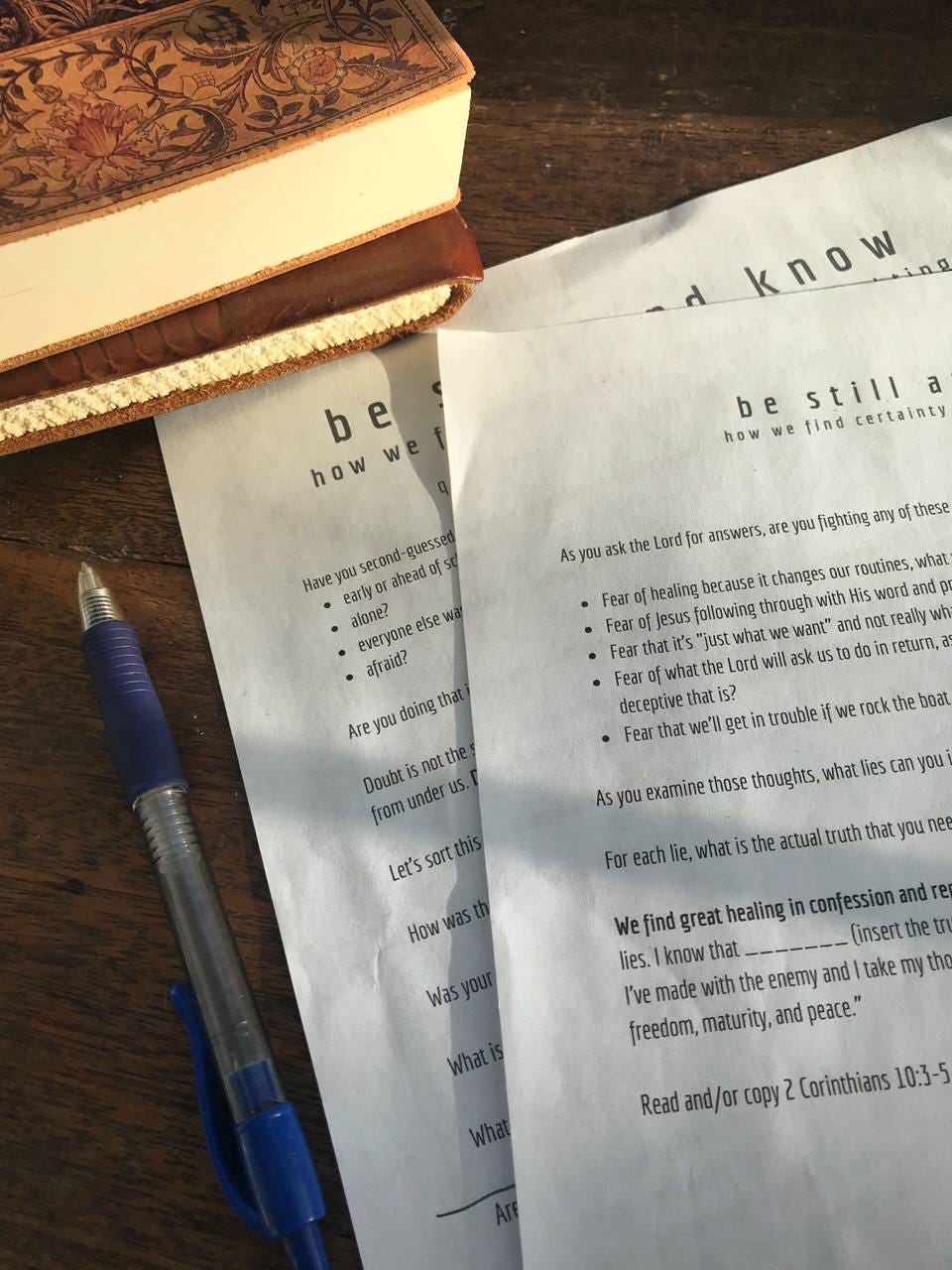

For years now I’ve shared a small section of my personal Bible reading with a photo, because God’s word is for every day, all parts of our days and lives.
Everyday photos: dishes, mountains, cats, crochet. Sometimes blurry, imperfect photos. Because our days are sometimes blurry and imperfect, and the Word still applies to them.

Due to space restraints and the fleeting attention span of the average scroller, I usually only post a few verses that can be basically understood without a ton of other context.
Here’s what I said about it a while back:
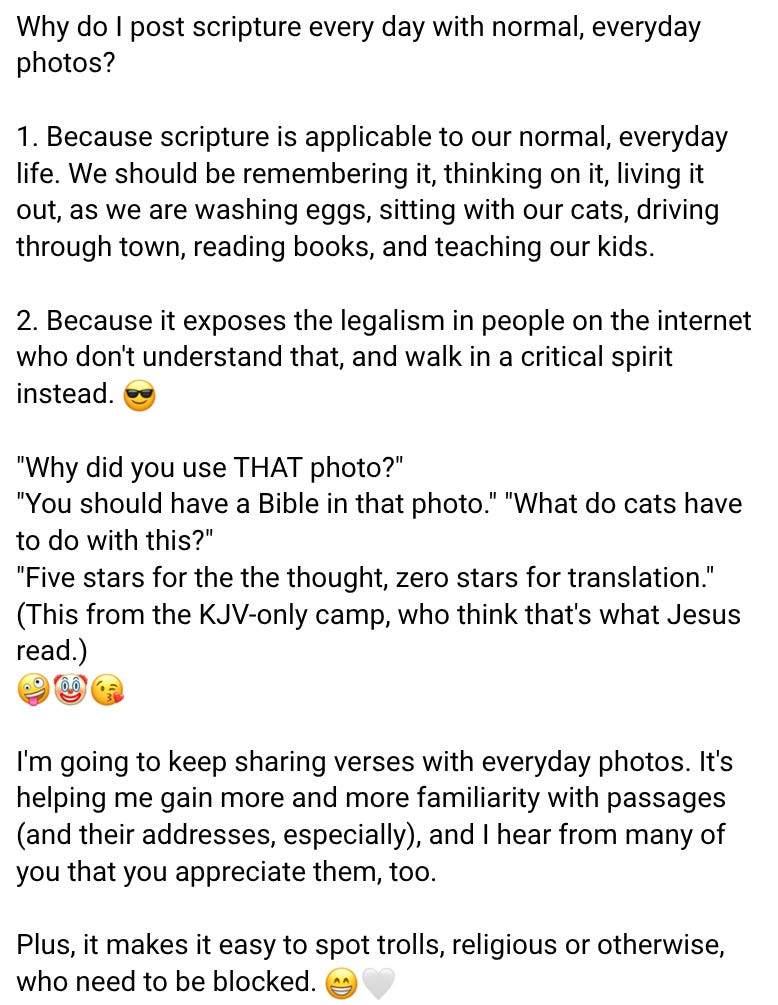
These verses are only a small drop in the bucket. If we profess to know Jesus, the Living Word, we need to know the written word…the whole thing.
And if we don’t know the written word in context, we don’t know it at all.
I heard this from a conference a few months ago and it astounded me:
We did a show of hands a few years back at a pastor’s conference – not one of ours, but another ministry – and we asked the pastors, “How many of you have read the whole Bible?”
Only 40% of the crowd had read the whole Bible. This was in America, in Southern Cal, Orange County.
One of the pastors said, “Well, I’m not dealing with theology, I’m dealing with people’s issues.”
And I’m like, “Well, that’s why your people have so many issues.”
At a pastor’s conference, only 40% of the crowd of pastors had actually read the entire Bible.
WHAT.
The other 60% are those who presume to teach the Bible without actually having fully read it themselves.
This explains a lot of our modern church culture, hmm?
Even regarding the 40% of pastors who had read the whole Bible, we have to ask…have they only read it once, and then checked it off the list? I mean, if 60% hadn’t even read it all the way through, how many of those who had read the Bible…actually read it daily? You know, reeeead it, as in, they study and examine it, and keep pursuing truth?
Instead of growing deep and wide, diving in and exploring broadly, many of us are standing at the shoreline just skipping rocks while thinking we know what’s in the water.
We have a Christian culture disastrously low in Biblical literacy and woefully high in presumption.1 Or, to put it another way, we have churches full of armchair quarterbacks who’ve hardly read the playbook while claiming to be expert enough to teach others about it from the pulpit and elsewhere.
Who is wise and knowledgeable among you? Show by your good life that your works are done with gentleness born of wisdom.
But if you have bitter envy and selfish ambition in your hearts, do not be arrogant and lie about the truth.
This is not wisdom that comes down from above but is earthly, unspiritual, devilish.
– James 3:13-15
Let’s talk about Biblical literacy.
Biblical literacy is not just reading and checking off chapters and getting all the way through, cover to cover.

Biblical literacy means understanding context and language, which includes history and grammar. If you didn’t like those in school, sorry, but they’re necessary if you want to understand scripture rather than making a quick surface application of some random verse in Bible Roulette.
In full disclosure, I grew up on Bible Roulette as a kid, and I don’t know that any church leader was necessarily to blame for this. And later when I started reading the Bible on a daily basis, I definitely read it to check it off more than anything else. It was better than nothing in the begging. Not great, of course, but at least it helped me start to gain a familiarity with the overall picture and timeline of the Old and New Testaments.
But I wasted years just checking off readings. Probably the first ten(ish) times I read it all the way through were more about checking off than digging in (also yes, I can be a slow learner).2
So even in reading it over and over and over, we can easily miss the point. I sure did.
[On a related note, in those days I was under the impression that I hated history because I had hated history classes in school. Then I married a history nerd. That history nerd was not great at grammar and he could misspell words with such creativity that he confounded spellcheck…and he, of course, married me.
God is hilarious and stubbornly redemptive.
It turns out, I don’t hate history. And Vince became a writer.]
Reading only a few verses a day that are taken out of context (whether they are my social media posts, or some influencer’s Instagram post, or two minutes of Bible Roulette, or whatever) is probably worse than reading nothing at all.
Is that shocking? It’s counter to what we’ve been told all along: “If all you can read is a few verses a day, just do that.”
But no, don’t do that. I mean, do that if you have to on certain days, but don’t make it your daily practice and then call it “Bible reading” or “Bible study.”


I have been the mom with seven or eight kids and zero time to go to the bathroom, much less ten minutes to sit on the couch and have quiet time that looks like something you’d see on Pinterest. I’m not arguing against the bits and pieces, here and there, whenever you finally get a free few minutes to breathe.

I’m arguing against the false sense of security and accomplishment achieved by the routine reading of a random few verses here and there, not digging any deeper into their actual application or context, and then moving about our business as though we’ve actually attained some mystical experience and understanding that we don’t actually possess.
That’s what’s not okay.
As a result of this, we have leaders, teachers, pastors, everyday people spouting things that don’t even exist in the Bible but claiming it does because they saw something like it in there somewhere but failed to actually delve into the context to understand the full truth of it.
Or, what’s more common, they assume a thing — “headship” is a good example — and then read it into the Bible because it fits their worldview or what they’ve always been taught, and then create doctrine out of it rather than understanding what those passages actually refer to and investigating whether their concept of it is even in the Scriptures. (Spoiler alert: It’s not.3)
This leads to divisions, arguments, pomposity, stubborn digging in of heels, the diminishing of the gospel, and all kinds of nonsense.
Now I appeal to you, brothers and sisters, by the name of our Lord Jesus Christ, that all of you be in agreement and that there be no divisions among you but that you be knit together in the same mind and the same purpose.
– 1 Corinthians 1:10
Why does the New Testament talk so much about false teachers? Because they were dealing with them at the time of the writing. And also, because God knew we would be dealing with them, too.
So many have not learned, and then in their lack of learning they have taught others.
But here’s the thing: False teachers aren’t those who teach things you don’t personally like or approve of. False teachers are those who teach something opposed to what God says.
Jesus’ words about this:
But woe to you, scribes and Pharisees, hypocrites! For you lock people out of the kingdom of heaven. For you do not go in yourselves, and when others are going in you stop them.
Woe to you, scribes and Pharisees, hypocrites! For you cross sea and land to make a single convert, and you make the new convert twice as much a child of hell as yourselves.
– Matthew 23:14-15
None of us want this kind of rebuke from the Lord.
So can we set aside what we’ve “always been taught” and always believed and always held onto, and just go back to what the Bible – in fullness, wholeness, and complete context – actually says? Can we go back to what Jesus lived out? Because this is what He is calling us to do.
If we see a section in the Bible that makes us ask questions, we should ask them. We should not brush them off and just say, “Well, it’s in the Word so it must be true.” God gave us a brain to use and the whole Word to examine, and this is not critical thinking. This is cult-like ignorance.4
Here are some verses also in the Word that should not be taken out of context and put into universal application:
Your meetings do more harm than good.
— 1 Corinthians 11:17
Now concerning the matters about which you wrote: “It is good for a man not to touch a woman.”
— 1 Corinthians 7:1
So I made up my mind that I would not make another painful visit to you.
— 2 Corinthians 2:1
I wish those who unsettle you would castrate themselves!
— Galatians 5:1
And of course, the most abused and mistranslated:
I do not permit a woman to teach or to have authority over a man; she is to keep silent.
— 1 Timothy 2:12
I mean, we wouldn’t want to fuss with footnotes, original language, cultural context, or any of that other inconvenient stuff…it’s just so much easier to avoid meetings, not touch women, not visit people, castrate offenders, and forbid half of humanity from teaching or talking.
Sigh, snicker.
Here’s the good news (lowercase, not uppercase): We can all do better, and we can do it today.

We can all dive deeper, read wider, pursue more. We can all repent and admit we don’t know as much as we need to or want to.
As you therefore have received Christ Jesus the Lord, continue to walk in him, rooted and built up in him and established in the faith, just as you were taught, abounding in thanksgiving.
Watch out that no one takes you captive through philosophy and empty deceit, according to human tradition, according to the elemental principles of the world, and not according to Christ.
— Colossians 2:6-8
We can all honor each other and listen, and set boundaries with those who won’t reciprocate.
For where there is envy and selfish ambition, there will also be disorder and wickedness of every kind.
But the wisdom from above is first pure, then peaceable, gentle, willing to yield, full of mercy and good fruits, without a trace of partiality or hypocrisy.
And the fruit of righteousness is sown in peace by those who make peace.
– James 3:16-18
There are human traditions to be found all throughout Christianity that are only loosely based in the Bible and not at all what it intended.
I urge you, brothers and sisters, to keep an eye on those who create dissensions and hindrances, in opposition to the teaching that you have learned; avoid them.
For such people do not serve our Lord Christ but their own appetites, and by smooth talk and flattery they deceive the hearts of the simple-minded.
– Romans 16:17-18
Education is not expensive.5 But ignorance is, and it’s costing the Kingdom.
It’s a good time to examine those things we always thought were true, and ask ourselves: Is this actually in the Bible, in context? Or is this just something that some in the Church have taught forever, and never course-corrected?
Because those are not always the same thing.
Wisdom is preserved for those who don’t get caught up in offense, pride, and stubbornness, but are instead caught up in wonder of His goodness.
Subscribe here to receive these posts free to your inbox. Learn more about our ministry here.
footnotes
- We also have a mainstream culture disastrously low in any literacy, and still woefully high in presumption. But that’s a discussion for another blog. ↩︎
- The closest I’ve come to reading other books multiple times is probably…I’m guessing, but I think 5 times or so each of Lord of the Rings, Pride and Prejudice, Wind in the Willows, and that great classic, The House at Pooh Corner. None of which I grew up reading as a child, except for one I tried (but not really) and hated. Ironically, as I type this, we’re reading that one again to all the kids, and it is my hands-down favorite read aloud ever. ↩︎
- If you’d like a video resource on this (under 30 minutes) this is a thorough one. Or if you prefer to read, this excellent short article confronts the modern erroneous use of the term “headship” which is not even in the Bible. The author makes the point that “loveship” would be a more accurate term and make more sense Biblically, because although it, too, is not found in the Bible, husbands are told to love their wives far more (6 times) than they are mentioned as the head (twice) or leader (zero times), or than wives are told to submit or “be subject” (3-4 times, depending on how you count).
Further, it is important to note that “be subject” or “submit” does not equate to “follow.” See Ephesians 5:21, which prefaces two of the instances for women: “Be subject to one another out of reverence for Christ.” This does not mean “Follow each other.” Here is a great article from Marg Mowczko on that, and here is another brief one. ↩︎ - For example, David was “a man after God’s own heart.” Does this mean he was above reproach and we can’t be honest about his violent, lecherous behavior? Must we therefore assume that whatever he did was justified, or that it should at least be minimized?
Some people think so, but I’m not one of them. God’s use of imperfect people doesn’t equal His categorical endorsement of their actions. (See also this video on Judges.) ↩︎ - My favorite free Bible study resources are BibleProject and AWKNG. ↩︎