awake: why we’re thankful in spite of the shaking

Like many nights, I was already awake in the dark, in the wee hours, nursing Kavanagh. So I probably heard it coming but thought it was just the cats making noise downstairs. But then the noise turned into slight shaking, and then unmistakable rattling.

My first instinct is always to glance at the clock: 3:23. It rumbled in layers, increasing in volume and shaking – long enough that I wondered three separate times if this one would be as bad or worse than the 7.2 we had a couple years ago – before it finally slowed down, stopped, and everything went still.

awake: why we're grateful in spite of the shaking

But this one was only a 5.1. Vin checked on the kids and reported that some were awake, and some slept through it.

And then another one hit. But it was smaller, just 4.0.

Hours went by, and I was awake for most of it. So around six when I heard the dull, distant noise, I wasn’t surprised when another one came, smaller than the first but bigger than the second – we learn to judge these things based on duration, intensity, and whether or not certain wall hangings rattle. The website said it was 4.5 and apparently there had also been another one just half an hour earlier, but it was little and I never noticed. I probably thought it was one of us shifting in the bed, or Knightley stretching at the foot of it.

That evening I heard the noise again and immediately stilled, looking at the clock, wondering if another was going to hit. But no, nothing that time, so it must’ve just been the heavy tread of someone walking downstairs.

And as I realized it was nothing, I had a picture of the Biden-Harris campaign, and their fraudulent claim to victory.

The Lord knows the days of the blameless,
    and their heritage will remain forever;
they are not put to shame in evil times;
    in the days of famine they have abundance.

– Psalm 37:18-19

The mainstream news, social media, and anyone who gets most of their information from those entities and actually believes it, almost immediately proclaimed their victory and have continued to do so.

They did it, and still do it, in spite of enormous and mounting evidence of fraud, changes from recounts, and active and upcoming court cases. The streamers thrown in celebration are actually giving them more rope to hang themselves with.

They did it while suppressing information, censoring articles about criminal behavior, and “fact checking” posts they didn’t like.

They’re doing it about the election and they’re doing it about the virus and the jab and they’ll keep doing it about whatever else they want, if they can get away with it.

Meanwhile, governors continue to lockdown states and mayors keep locking down cities. Churches keep closing their doors. And in a move that looks very much like unethical job security, doctors who know that mask wearing both creates and aggravates terrible health conditions (see also here, and here, and here, and here, for starters) keep requiring them anyway.

It’s like hearing the distant rumble, wondering if it’s going to be the big one.

Is this the end?

In the upper rooms there were little rows of hard beds, and on every wall there was a notice and a list of Rules. Pippin tore them down. There was no beer and very little food…and Pippin broke Rule 4 by putting most of the next day’s allowance of wood on the fire.

– J.R.R. Tolkien, The Return of the King

But no, I don’t believe it’s the end. I think it’s the tread of heavy feet, or at most, the relief of pressure in a small, harmless way that feels threatening at first but turns out to be nothing but the exhalation of pent-up gas.

The Lord laughs at the wicked, for he sees that his day is coming.

– Psalm 37:13

It’s causing us to stop for the moment and examine our surroundings, endure the brief threat, but overall it will bring alignment to that same environment, and prevent the big one from occurring.

The shaking exposes fault lines, weak places that require reinforcement.

“You’re arrested form Gate-breaking, and Tearing up of Rules, and Assaulting Gate-keepers, and Trespassing, and Sleeping in Shire-buildings without Leave, and Bribing Guards with Food.”

“And what else?” said Frodo.

“That’ll do to go on with,” said the Shirriff-leader.

“I can add some more, if you’d like it,” said Sam. “Calling your Chief Names, Wishing to punch his Pimply Face, and Thinking you Shirriffs look a lot of Tom-Fools.”

– J.R.R. Tolkien, The Return of the King

The excess shaking is teaching people to be alert at the slightest rumble. We’re awake, alert, alarmed at the threat, prayerful for safety, and the shaking results in justice as corruption is exposed and people decide which authority they’ll obey.

[The Chief] doesn’t hold with folk moving about; so if they will or they must, then they has to go to the Shirriff-house and explain their business.”

“You ought to be ashamed of yourself having anything to do with such nonsense….You can give it up, stop Shirriffing, if it has stopped being a respectable job,” said Sam.

“We’re not allowed to,” said Robin.

“If I hear not allowed much oftener,” said Sam, “I’m going to get angry.”

– J.R.R. Tolkien, The Return of the King

And there’s no doubt, the threat is real and dire. Many Christians shrug and say, Well, our hope was never in a president, persecution grows the church anyway, c’est la vie, what can you do – but if socialism came to any of our doors and completely removed our freedom of speech, our ability to purchase things we need, or force unwanted medical “care” upon our children, there would be no shrugging. These are not “oh, whatever” offenses. We’ve already begun to see them in social media censorship, threats from certain employers, and in the difficulty to get proper healthcare if you cannot wear a mask…ask me how I know.

“There’s hundreds of Shirriffs all told, and they want more, with all these new rules. Most of them are in it against their will, but not all. Even in the Shire there are some as like minding other folk’s business and talking big.”

– J.R.R. Tolkien, The Return of the King

And some people are happy to mind your business for you, shaming and blaming and accusing, wagging their fingers in all their self-righteous virtue signaling. Bless their hearts, they believe everything the mainstream media tells them.

But there are more people who don’t. They tend to have better manners and aren’t as loud about it. But make no mistake, they will get loud if pushed to do so.

“Raise the Shire!” said Merry. “Now! Wake all our people! They hate all this, you can see: all of them except perhaps one or two rascals, and a few fools who want to be important, but don’t at all understand what is really going on.”

– J.R.R. Tolkien, The Return of the King

This week, we are gathering.

Our neighbors are elderly missionaries, and they invited us to pray with them a few nights ago. They want to make it a regular thing. They’re not unwise, but they’re not afraid, either. Over tea and candlelight, we held hands and called on God to move in our country.

Last night we gathered with friends at church, studying forgiveness and honor and submission and authority. We honor the position, not the behavior. We obey unless we’re told to do something against God’s word. We shared homemade food and phone numbers, and talked about how, contrary to pop culture, silence should not be mistaken for betrayal, consent, or inactivity.

Tomorrow we gather with our oldest son and my dad and other family. There will be hugging. There will be political talk. There will probably be discussion of court hearings, more evidence of fraud, and likely – this is Alaska – a comparison of ammo inventory.

And I’m grateful for all those things, and more.

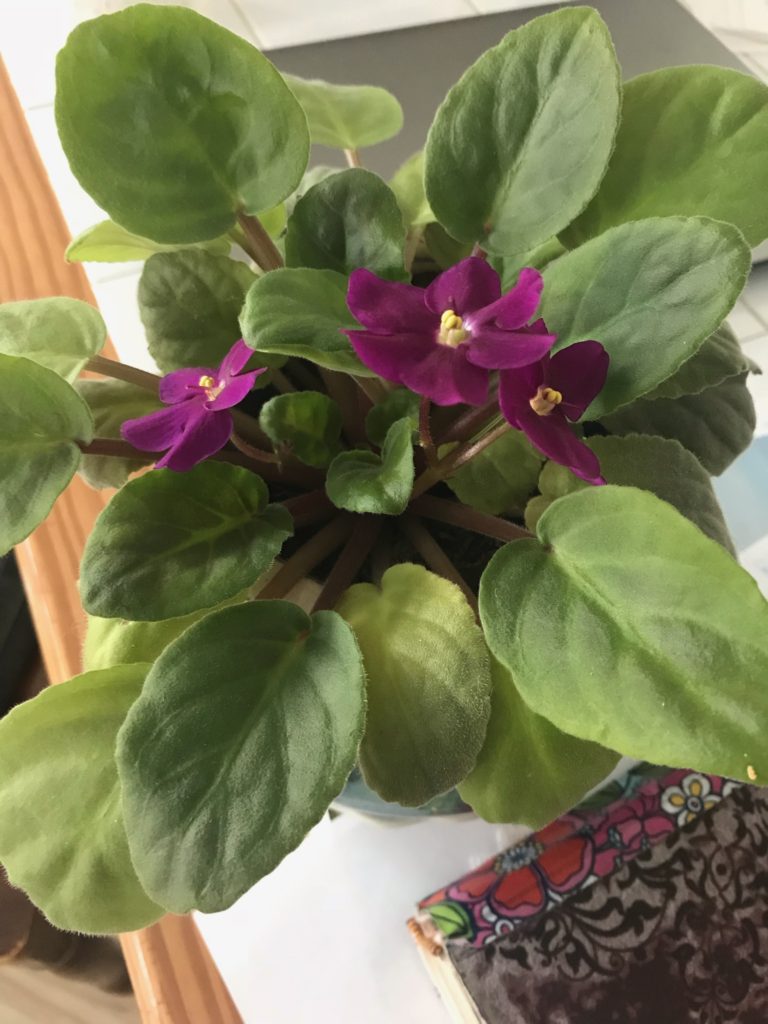
People are praying for us. Andrey is catching up in school and Reagan is reading five-letter words. Our neighbors are the cutest. People all over are dropping the bomb on election fraud. God is giving us wisdom and new ideas; our book sales are up and I’m excited about the next project already. And my African violet, which hasn’t bloomed since I bought it who knows how long ago, has flowers again.

I showed it to Vin this morning, and he said, “It’s the return of the King.”

And I think it is, or something like it. Thanksgiving is already here.

with vision: reading with Grandma

Kav’s hair was all tufted and feathery-soft after his bath, copper in some lights and red in others. I sniffed him and ruffled it, and before I knew what I was saying, these words came out of my mouth:

“His hair is so pretty.” I paused. “Listen to me, I sound just like Grandma.”

with vision: reading with Grandma

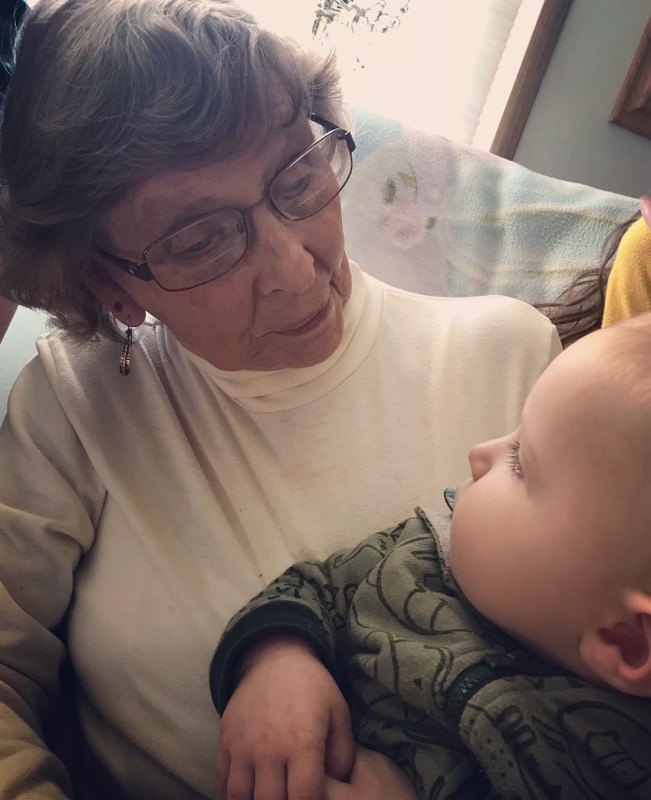
For nineteen years Grandma has called our babies’ hair pretty, and she doesn’t care whether it’s a boy or a girl she’s crooning over. Anyone under ten is fair game.

The next day, we drove the wavy road to her house in forty degree weather. Puddles from the last few days’ rain on the roadside trail were still glazed with ice in the early afternoon, and you could see their frozen lines crisscrossed on their surface. If you grew up in cold weather, you can imagine the perfect crunch these puddles must make if you walked on them. But no one had walked on these ones yet; through miles of the road, they were all still untouched.

Forgive me for going on about the puddles. We’ve been listening to an audio version of Nicholas Nickleby on these drives between Wasilla and Palmer, and Dickens makes me verbose.

It’s a forty minute drive all the way past the river, and Kav’s tolerance for car rides usually expires around the 25-30 minute mark (I don’t think this is Dickens’ fault). So since we don’t make it over as often as we’d like, we planned a two-for-one-deal this time: Stop at Grandma’s house before heading to Dad’s, where the kids were going to rake leaves while Vin put the winter tires on the Stagecoach.

Grandma turned 88 this month. She’s been losing her vision for years; her peripheral vision is still good, but faces are hard to see and reading is almost impossible. She misses driving and seeing people, but she especially misses reading.

And she doesn’t like audiobooks and I don’t blame her; we both must have similar attention spans.

But I was praying about it the week before and an idea struck me, so I asked her about it that day:

What if we could read to her from home? What if we recorded some of our school readings out loud, and burned them to a CD, and gave her a new one every time we came over?

It would be different than a normal audiobook. It would be us in all our mess and glory – Finnegan’s interruptions, questions from the kids, babbling from Kav and meowing from the cats – and it would be less like being alone or being read to by some stranger (professional though they may be), and more like we’re there with her.

And she liked that idea. She also liked knowing that it would be help us with school, motivating the kids to practice reading aloud.

So we’ve been filling the Voice Memo app on my phone with chapters and we’re halfway through several books now…and so far, only one of them is interspersed with me bossing a toddler to stop jumping on the couch, stop wrestling with his baby brother, and stop driving his racecar over the cat.

See? Like I said, it’s just like we’re there.

I called her again a few days ago – her number is the only one I still dial because it hasn’t ever changed – and gave her an update on our progress. Who’s reading what, what’s almost done, which characters get silly voices.

“Some people are just readers,” she said. “Other people read with vision.”

And then she started telling me about when she was a kid. They had poor light in the evening but she read in it anyway; she needed glasses long before she got them, and maybe that’s at least partly why her vision is gone now.

“It was a different world. People will never know what a different world it was back then.” She talked about the rationing in World War II. Sugar was rationed; it was a rare occasion when you could go to the store and see bags of sugar on the shelf. Paper products were hard to come by.

So many things are ever so much better, she said. Our lighting is so much better now. People have no excuse for not being readers these days. It was an altogether different world then.

But that day when we visited, it was the normal, familiar world of Grandma’s house: We dropped off cookies, the boys used her recliner as a merry-go-round, and we fortified ourselves with hugs before heading to Dad’s for yardwork.

And when Finn went up to her for his hug, these words came out of her mouth:

“Look at you, and your pretty hair!” she said, running her fingers through his blond tufts. But we saw that coming, I guess.

dark to light: change that does a work in us

It is officially spring in Alaska: The willow trees erupted in stars, change is everywhere, and Vince is painting the kitchen. Don’t rub it in, though.

The man hates painting, but the jagged four-foot long tear in the sheetrock from last winter’s earthquake necessitated it. The kitchen walls were dark brown, the crack was stark white, and there’s no hiding it without addressing it – it must be mudded, retextured, and repainted.

dark to light: change that does a work in us

I think he’s cute in his painting clothes, with his hat flipped backwards. I also think I’m cute with a screwdriver, taking out the switch covers to help prep, easing my conscience before leaving him with all the real work while I escape upstairs to write.

The kitchen is going from brown to white, from dark to light, but the change is everywhere else, too, a sense of transition that feels like impending birth. We’ve been here before. Different times and circumstances but the same level of stress and uncertainty, and we survived. Thrived, even, and sometimes saw miracles and breakthrough. Other times, we just muddled through. In some ways we’re still muddling, still waiting for the resolution at the end of the story, praying the story ends well.

There’s nothing wrong with acknowledging how hard it is. The shifting ground, the earthquake, the trauma – we don’t pretend it was a little breeze when it knocked over trees, and we don’t pretend something was just a little tremor when it shook our foundations. We recognize the threat, and we inspect for damage so that damage can be dealt with.

Just as it is no big deal when we love those who love us back, it is also no big thing to be at peace when life is calm. But it is an entirely different thing to love without return, just as it is also an entirely different thing to feel peace and fight for calm when the world is shaking.

Whatever it is, we know He moves in the midst of it. These uncomfortable seasons bring questions to the surface and draw things out of us, and it’s productive.

No, really. Change does a work in us, as long as we don’t give way to fear.

And isn’t that the hardest part? I don’t think we ever graduate from fighting fear. Every time we up the ante and leave our comfort zone, we just graduate to new phases of fear and new ways to win over it. We feel the knots writhe in our gut over what’s going to happen. We wait for the news, the diagnosis, the prognosis. We wait for anything that’s certain, in the midst of weeks that feel saturated with uncertainty.

Fear, at its root, is often more than just being afraid of an outcome. Often it is fear that we failed – we failed to heal, we failed to fix that thing, we failed to protect that person, we failed to predict the future so that event didn’t occur, we failed to accomplish what we wanted to do.

We lost. Game over.

We failed to be God. And when this is the case, admitting as much means also admitting that maybe, just maybe, we’ve made ourselves into an idol.

And this stupid sheetrock is preaching to me. Listen:

Did the sheetrock fail in the shaking? Yes, and no. It cracked, but held. It wasn’t meant to do the foundation’s job and hold up everything. It was meant to do its own job, and bear the weight it was given, and let any failure be used for good – because change, and even failure, does a work in us when we let it. We go from dark to light, too.

We want perfection, and when we don’t achieve it (because we are, of course, imperfect humans) instead of glorying in what we did reach, we feel the lack and the loss. We feel the distance between where we got to and where we wanted to be.

And the enemy throws it right at us, taking it a step further: Not only did we fail, he hisses, but we are failures. The gap widens. The bad hand seems worse.

He’s a liar, we know. But knowing doesn’t always fix our feelings.

Our feelings are harder to reign in and correct. The only thing that fixes feelings is facing them, and that doesn’t seem like good news at first because we know that behind these Big Feelings are some even Bigger Feelings that we’d rather not admit. (We don’t just paint over the crack; we must also retexture. Gah.) In fact, ignoring those Bigger Feelings is often what allows the lie to creep in and hurt so bad in the first place.

It is the crack in our facade, and there’s no hiding it. It must be dealt with.

Facing these things is hard. So much pain. Ignoring it only allows it to build up for later, the pressure creating strain and damage on souls who were never meant to bear the weight of perfection, and denial, and holding it all in.

I recently read that you have to accelerate your pain to accelerate your progress. And I believe it’s true – one of the ways we accelerate both pain and progress is to face those fears we’d rather ignore, the grief we’d rather stuff, and the failures caused by our own imperfection.

There’s no help for failing. We all fail. None of us are perfect. But we wanted to be. So finally admitting failure is actually healthy, and good, and right – a victory in itself.

If you’ve been up all night and cried till you have no more tears left in you – you will know that there comes in the end a sort of quietness. You feel as if nothing is ever going to happen again.

– C. S. Lewis, The Lion, the Witch, and the Wardrobe

The victory comes the morning after the deep grief of facing it all — the change, the imperfections and uncertainties, and the potential clean-up operation — when you look at yourself in the mirror and see resigned peace. And it hurts. But denial hurts worse, because refusing to acknowledge what is broken denies the healing that needs to seep into our cracked areas.

The consequences and what-ifs were all laid on the table. And instead of folding, you put everything in, because you know that in the end, you win. It is the only way we go from dark to light.